
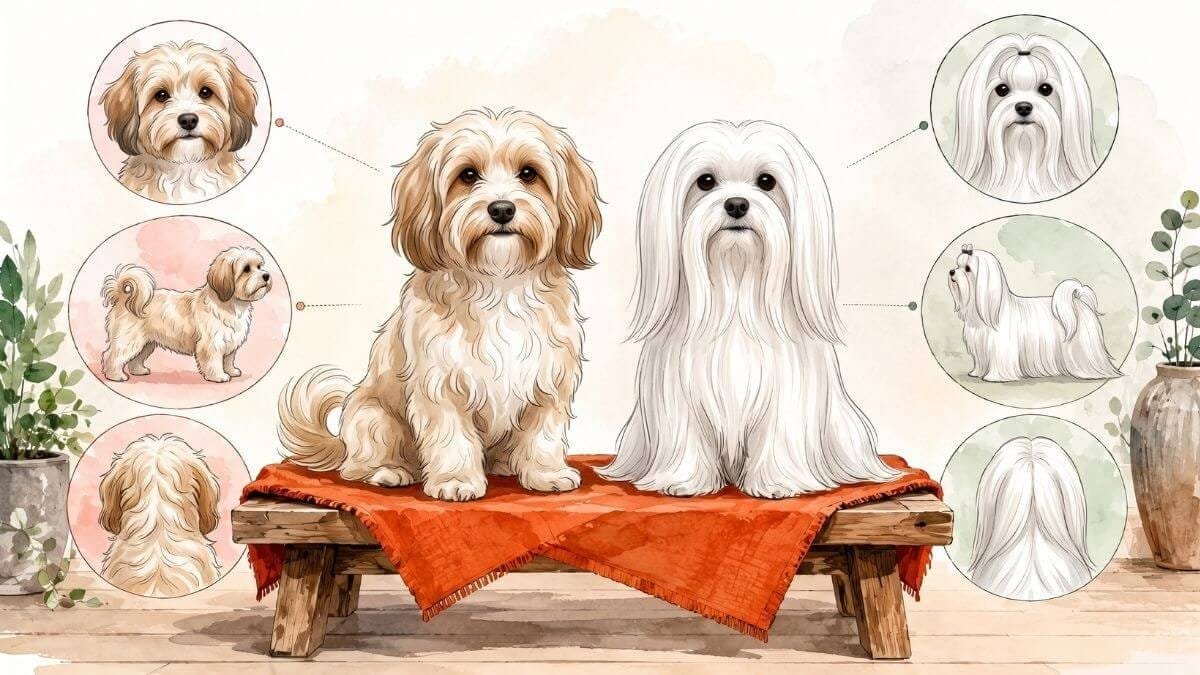
Both of these dogs sit on the American Kennel Club’s low-allergen list, both are toy-sized, and both barely shed. On the thing most buyers search for, this pair is genuinely level.
So the useful comparison is not which one is safer. It is which one you can actually keep up with.
I will say up front that one of these breeds asks noticeably more of you every single day, and it is not the one people expect. The hub for these head-to-heads is maltese vs yorkie if you want the pair where the labels really do differ.
The short version
| Havanese | Maltese | |
|---|---|---|
| Honest label | AKC low-allergen | AKC low-allergen |
| Coat | Soft wavy double coat | Straight silky single coat |
| Sheds | Very little | Very little |
| Daily upkeep | Moderate | Heavier, plus daily face care |
| Temperament | Sociable, playful, more adaptable | Gentle, devoted, more of a lap dog |
Who this is for: you want a small low-shedding companion, someone at home reacts to dogs, and these two are on your shortlist. Decide before money changes hands.
If asthma or a serious reaction history is in the house, treat both as background reading. An allergist and a supervised visit come first, because neither breed clears anyone on its own.
Key takeaways
- Both are AKC low-allergen and both shed very little. On the allergy label this is a tie.
- Neither has ever had its allergen output measured directly. The listing rests on coat type, not a lab result.
- The Havanese has a double coat, so more dander stays trapped near the skin until you comb it out.
- The Maltese has a single silky coat and a heavy self-grooming habit, so more of its allergen rides on dried saliva.
- The real differences are grooming load, tear staining, and temperament. Those decide the next fifteen years.
- One thing circulating on this topic is simply wrong: the Havanese is not a heavy shedder.
Havanese vs maltese allergies: is one better for allergy sufferers?
Neither, and anyone claiming otherwise is guessing.
Both breeds carry the AKC low-allergen listing, both have coats that hold loose hair rather than dropping it, and no study has measured either one’s allergen output, let alone compared them. What we have is a set of measurements across other breeds, and those consistently show that within-breed variation swamps between-breed variation.
I went looking for a Can f 1 number on either breed and came back with nothing. Neither the Havanese nor the Maltese has ever appeared in a published breed measurement, which is worth knowing before you trust a ranking.
The evidence that does exist points away from the label entirely. A 2012 study in the Journal of Allergy and Clinical Immunology measured Can f 1, the main protein from a dog’s skin and saliva that people react to, across breeds marketed as hypoallergenic against ordinary breeds. The marketed dogs carried more of it in their coats, and their homes were no cleaner.
Both of these breeds are on a list built from coat type, not from measurement.
That is not an argument against either dog. It is an argument for testing yourself against the specific animal, which costs nothing but an afternoon.
The Havanese vs Maltese scorecard
Both land at a C in the site’s small-breed grading, so I graded the pair on what actually separates them day to day.
| Decision vector | Havanese | Maltese | The honest note |
|---|---|---|---|
| Allergen confidence | C | C | Both AKC low-allergen, neither ever measured. A tie built on the same missing evidence. |
| Loose hair in the home | B | B | Both genuinely low shed. Hair stays in the coat until combed. |
| Dander held in the coat | C | B | The Havanese undercoat traps more near the skin. Skip a few days and you release it all at once. |
| Saliva spread | B | C | The Maltese self-grooms more, and a white coat shows where the saliva has been sitting. |
| Daily upkeep | B | C | The clearest split. The Maltese adds daily face and eye care the Havanese does not need. |
| Adaptability | B | C | The Havanese handles a busier, noisier household and copes better with change. |
The allergy row is a tie and the upkeep rows are not. That is the whole decision in one table.
Havanese vs maltese shedding: which one sheds more?
Neither, and one popular claim on this topic is flatly wrong.
Both breeds are low shedders. You will see it written that the Havanese is a heavy shedder, and that is an error worth correcting: the Havanese has a soft double coat that holds shed hair in the coat rather than dropping it. The hair ends up in your comb either way.
The difference is where the hair and dander sit while they wait for you.
| Coat trait | Havanese | Maltese | What it means for you |
|---|---|---|---|
| Structure | Soft double coat, wavy | Single silky coat, straight | The Havanese holds more dander close to the skin |
| Shedding | Very low | Very low | Neither drops hair around the house |
| Matting | Moderate, worse during the coat change | Fast, the silky coat tangles easily | Mats are pockets of dander a bath cannot reach |
| Brushing | Every day or two, to the skin | Daily, to the skin | Line-brush, do not just sweep the top |
| Professional groom | Every 6 to 8 weeks | Every 6 to 8 weeks | A shorter clip makes everything else easier |
| Bathing, allergen control | Closer to twice a week if the skin tolerates it | Coat allergen returns to baseline in about three days | |
One Havanese-specific thing to plan for. Somewhere between about nine and fourteen months a Havanese goes through a coat change as the adult coat comes in, and for a few months it mats far faster than usual. Owners who quit brushing daily during that window end up at the groomer for a full shave.
The bathing number is the one with real evidence behind it. A 1999 study in the Journal of Allergy and Clinical Immunology found washing cut recoverable coat allergen by about 84 percent, with levels back to baseline within three days, which is why allergy households wash far more often than coat health alone would suggest.
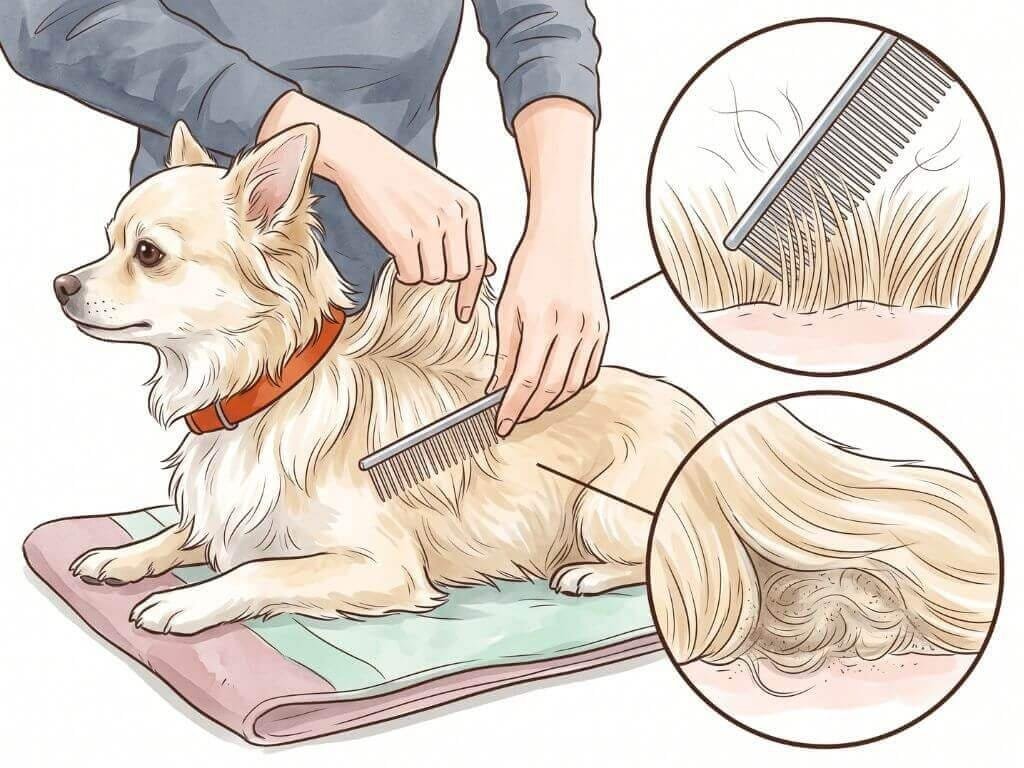
Both breeds hold shed hair in the coat instead of dropping it, so it ends up in your comb either way. That only works if the comb reaches the skin, as in the top view. The bottom view is the trap: a coat that looks perfectly tidy on the surface while a tangle builds underneath, which is what happens fastest during the Havanese coat change between about nine and fourteen months.
Havanese and maltese difference: size, coat, and health
The Havanese is the slightly bigger, sturdier dog with the easier face.
Both are toy breeds and both fit an apartment, but a Havanese runs roughly double a Maltese in weight and carries more bone. The Maltese is the more delicate animal, and the more visibly demanding one to keep clean, because everything shows on white.
| Standard | Havanese | Maltese |
|---|---|---|
| Height | 8.5 to 11.5 inches | 7 to 9 inches |
| Weight | 7 to 13 lb | Under 7 lb, 4 to 6 preferred |
| Typical lifespan | 14 to 16 years | 12 to 15 years |
| Coat colours | Many, including cream, gold, black, sable | White only |
| Face care | Occasional wipe | Daily, tear staining shows on white |
| Watch for | Luxating patella, eye disease, deafness | Luxating patella, dental disease, tear staining |
Tear staining is the underrated part of this decision. The Maltese is prone to excess tear production, and on a white coat that leaves reddish-brown marks that need daily wiping to control. Left damp, that facial hair becomes an irritated-skin problem, and irritated skin makes more dander.
The dedicated pages go deeper on each: are havanese hypoallergenic and are maltese hypoallergenic.
Havanese vs maltese temperament: which one fits your household?
The Havanese for a busy home, the Maltese for a quiet one.
The Havanese is the national dog of Cuba and was bred as a companion for a sociable, crowded household. It is playful, adaptable, quick to train, and generally fine with children, visitors, and noise. The Maltese is gentler and more devoted but also more sensitive, and it does best in a calm home with one or two people around.
Think about who is in your house at 6pm on a Tuesday. That answers this better than any breed description.
Both share one serious catch. These are companion breeds bred to be with people, and both are prone to separation anxiety if the house is empty from morning to evening. The Havanese copes marginally better, but neither is a dog for a household that is out all day.
If you want a dog that joins in, take the Havanese. If you want a dog that settles on you, take the Maltese.
Common mistakes
- Treating the shared low-allergen label as a tie-breaker. It is a tie, so it breaks nothing. Decide on upkeep and temperament instead.
- Believing the Havanese sheds heavily. It does not, and that claim appears on pages ranking for this exact comparison. Both breeds are low shedders.
- Underestimating the Maltese face routine. Daily eye and muzzle wiping is not optional on a white coat, and skipping it causes real skin irritation.
- Getting caught out by the Havanese coat change. Around nine to fourteen months the coat mats much faster. Plan for extra brushing rather than an emergency shave.
- Buying either breed for an empty house. Both are companion dogs prone to separation anxiety. This is the most common reason they get rehomed.
- Skipping the exposure visit. Neither breed has ever been measured for allergen. Your own reaction to the specific adult dog is the only real data you will get.
FAQ
Is a Havanese or a Maltese better for allergy sufferers?
Neither has an edge worth acting on. Both carry the AKC low-allergen listing, both shed very little, and neither has ever had its allergen output measured in a published study. Choose on grooming load and temperament instead, then test your own reaction with the specific adult dog before committing.
Do Havanese shed more than Maltese?
No. Both are low-shedding breeds, despite claims to the contrary on some comparison pages. The Havanese has a soft double coat and the Maltese a single silky one, and both hold loose hair in the coat until it is brushed out rather than dropping it around the house.
Which needs more grooming, a Havanese or a Maltese?
The Maltese, mainly because of its face. Both need brushing to the skin and a groomer every 6 to 8 weeks, but the Maltese silky coat tangles faster and its white hair shows tear staining, so it needs daily eye and muzzle wiping the Havanese can usually skip.
Which is bigger, a Havanese or a Maltese?
The Havanese, by roughly double the weight. A Havanese is 8.5 to 11.5 inches and 7 to 13 pounds, while a Maltese is 7 to 9 inches and under 7 pounds. The Havanese is also the sturdier of the two, which makes it the better fit for a home with young children.
Are Havanese or Maltese better for first-time owners?
The Havanese, usually. It is more adaptable, easier to train, and more tolerant of a busy or noisy household, and its coat is more forgiving of an imperfect routine. The Maltese suits a quieter home and an owner willing to commit to daily coat and face care from day one.
Sources
Sources (6)SourcesShow sourcesHide sources
- Vredegoor DW, Willemse T, Chapman MD, Heederik DJJ, Krop EJM. Can f 1 levels in hair and homes of different dog breeds: lack of evidence to describe any dog breed as hypoallergenic. Journal of Allergy and Clinical Immunology. 2012;130(4):904-909. https://pubmed.ncbi.nlm.nih.gov/22728082/
- Ramadour M, Guetat M, Guetat J, El Biaze M, Magnan A, Vervloet D. Dog factor differences in Can f 1 allergen production. Allergy. 2005;60(8):1060-1064. https://pubmed.ncbi.nlm.nih.gov/15969688/
- Hodson T, Custovic A, Simpson A, Chapman M, Woodcock A, Green R. Washing the dog reduces dog allergen levels, but the dog needs to be washed twice a week. Journal of Allergy and Clinical Immunology. 1999;103(4):581-585. https://pubmed.ncbi.nlm.nih.gov/10200004/
- Konieczny A, Morgenstern JP, Bizinkauskas CB, et al. The major dog allergens, Can f 1 and Can f 2, are salivary lipocalin proteins: cloning and immunological characterization of the recombinant forms. Immunology. 1997;92(4):577-586. https://pubmed.ncbi.nlm.nih.gov/9497502/
- American Kennel Club. Official standard of the Havanese. https://images.akc.org/pdf/breeds/standards/Havanese.pdf
- American Kennel Club. Official standard of the Maltese. https://images.akc.org/pdf/breeds/standards/Maltese.pdf
Related guides
- Maltese vs Yorkie: dander, shedding, and allergy odds. The comparison hub for this silo.
- Are Havanese hypoallergenic?. The Havanese on its own, and how little breed-specific data exists.
- Are Maltese hypoallergenic?. Why the silky coat still spreads saliva allergen.
If you made me choose, I would take the Havanese, and the reason has nothing to do with allergy. It is the more forgiving dog to live with, and a routine you can actually sustain does more for your symptoms than any difference between these two coats.
Which way are you leaning, and is anyone in your house going to be doing the daily brushing besides you?
— Adrian V.