
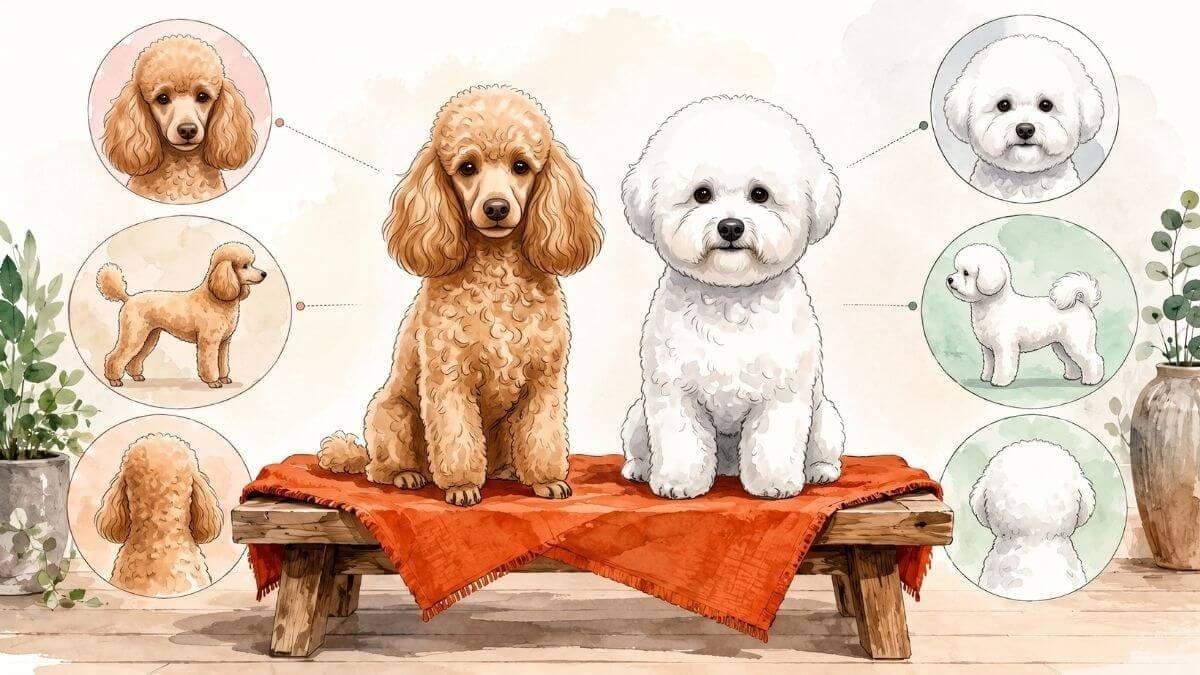
This is the closest thing to a fair fight in the small-dog allergy world. Both the Poodle and the Bichon Frise carry the American Kennel Club’s low-allergen listing, both barely shed, and both have curly coats that hold onto what they produce.
So the usual shortcut, pick the one that sheds less, does not help you here. Neither sheds.
I came into this expecting the Poodle to win on the numbers, the same way it wins on reputation. The one study that actually measured coat allergen across breeds says something more awkward, and I get into it below. If you want the head-to-head on a different pair first, the hub for these comparisons is maltese vs yorkie.
The short version
| Poodle (Toy or Mini) | Bichon Frise | |
|---|---|---|
| Honest label | AKC low-allergen | AKC low-allergen |
| Coat | Curly single coat | Curly double coat, soft undercoat |
| Sheds | Very little | Very little |
| Allergy verdict | Best-documented low shedder, measured high for coat allergen | Equally low shed, almost no breed-specific data |
| Best fit | Owners who want a trainable, busy-minded dog | Owners who want a softer, steadier companion |
Who this is for: you have narrowed a small low-shedding dog down to these two and someone at home reacts. Decide before a deposit, not after.
Asthma or any history of a strong reaction moves this out of blog-reading territory. See an allergist and arrange a supervised visit first, because neither breed clears you on its own.
Key takeaways
- Both breeds are AKC low-allergen and both shed very little. On the label, this one is a genuine tie.
- The tie-breaker is not allergen. It is coat structure, grooming load, and temperament.
- In the one study that measured coat allergen by breed, the Poodle came out near the top of the range, above a Labrador. Low shedding and low allergen are not the same thing.
- The Bichon has a double coat, so it traps more dander close to the skin. That is better for your furniture and worse if grooming slips.
- Neither dog is low-maintenance. Both need professional grooming every 4 to 6 weeks and brushing most days.
- The individual dog beats the breed. Two Poodles can differ more than a Poodle and a Bichon do.
Bichon frise vs poodle allergies: is one actually better?
Neither, on the evidence we have.
Both breeds sit on the AKC’s low-allergen list, and no study has ever measured the two against each other. What exists is a set of measurements across other breeds, and those measurements point away from the idea that any curly coat protects you. The honest position is that these two are equivalent on allergy risk and different on almost everything else.
Here is the finding the breeder pages never print. A 2005 study in the journal Allergy measured Can f 1, the main protein from a dog’s skin and saliva that people react to, on the fur of 288 dogs. Poodles averaged 17.04 micrograms per gram, the highest group in the study, against a Labrador Retriever’s 1.99.
I had to sit with that one for a minute, because the Poodle is the breed everyone recommends first.
The catch is what the number means. A high coat reading is allergen held in the coat, not allergen released into your rooms, and a curly coat is very good at holding things. That is exactly why the dog needs washing rather than why it needs avoiding.
So the Poodle’s reputation is half right. It really is a reliable low shedder, and it is not a low-allergen animal.
The Bichon has almost no breed-specific data at all, which is its own kind of honesty problem. Nobody has measured it, so its low-allergen listing rests on coat type, the same as most of the list. For the full breed picture there is a dedicated page on whether are bichon frises hypoallergenic holds up.
The Poodle vs Bichon allergen scorecard
I graded the pair on the six things that decide how an allergy household actually copes. Nothing reaches an A, because no dog earns one.
| Decision vector | Poodle | Bichon Frise | The honest note |
|---|---|---|---|
| Allergen confidence | B | B | Both AKC low-allergen. The Poodle has data and it is unflattering; the Bichon has none at all. |
| Loose hair in the home | B | B | A real tie, and the thing both breeds fully earn. Shed hair stays in the curl. |
| Dander held in the coat | B | C | The Bichon’s undercoat holds more against the skin, so a missed groom releases more at once. |
| Grooming load | C | C | Heavy for both. Every 4 to 6 weeks professionally, plus brushing most days. |
| Coat predictability | B | B | Both are settled purebred coats, so the adult dog is no surprise. This beats any doodle cross. |
| Calm in the house | C | B | The clearest split. The Bichon is steadier; the Poodle needs a job or it invents one. |
Read across and the allergy rows are a tie. The decision lives in the last two rows, which is not where anyone expects to find it.
Bichon frise vs poodle shedding: which one sheds less?
Neither, in any amount you will notice.
Both breeds shed at the low end of what dogs do, and both hold the shed hair in the curl instead of dropping it. You find the hair in the brush, not on the couch. That is the whole practical difference between these two and a Labrador, and it is real.
Coat structure is where they part ways. The Poodle has a single curly coat with no undercoat. The Bichon has a double coat, a soft undercoat under a coarser outer coat, which is why a well-groomed Bichon looks like a powder puff and a neglected one turns into a solid mat.
| Coat trait | Poodle | Bichon Frise | What it means for you |
|---|---|---|---|
| Structure | Single curly coat | Double coat, soft undercoat | The Bichon traps more dander close to the skin |
| Shed hair | Held in the curl | Held in the undercoat | Both keep hair off furniture; both need it combed out |
| Matting speed | Fast | Faster | A mat is a pocket of trapped dander you cannot wash through |
| Professional groom | Every 4 to 6 weeks | Every 4 to 6 weeks | Budget for it. This is not optional on either breed. |
| Brushing | Most days | Daily | Line-brush to the skin, not just over the top |
| Bathing, allergen control | Closer to twice a week if the skin tolerates it | Coat allergen rebounds to baseline in about three days | |
Curl itself is not a mystery, by the way. A 2009 study in Science found that three genes account for nearly all coat variation in purebred dogs, one each for length, curl, and the wiry furnished look. Both of these breeds are locked in for curl, which is exactly why their coats are predictable and a doodle puppy’s is not.
That predictability is the quiet advantage of buying a purebred here.
Washing is still the lever that moves the numbers. A 1999 study in the Journal of Allergy and Clinical Immunology found a wash cut recoverable coat allergen by about 84 percent, with levels back to baseline within three days.
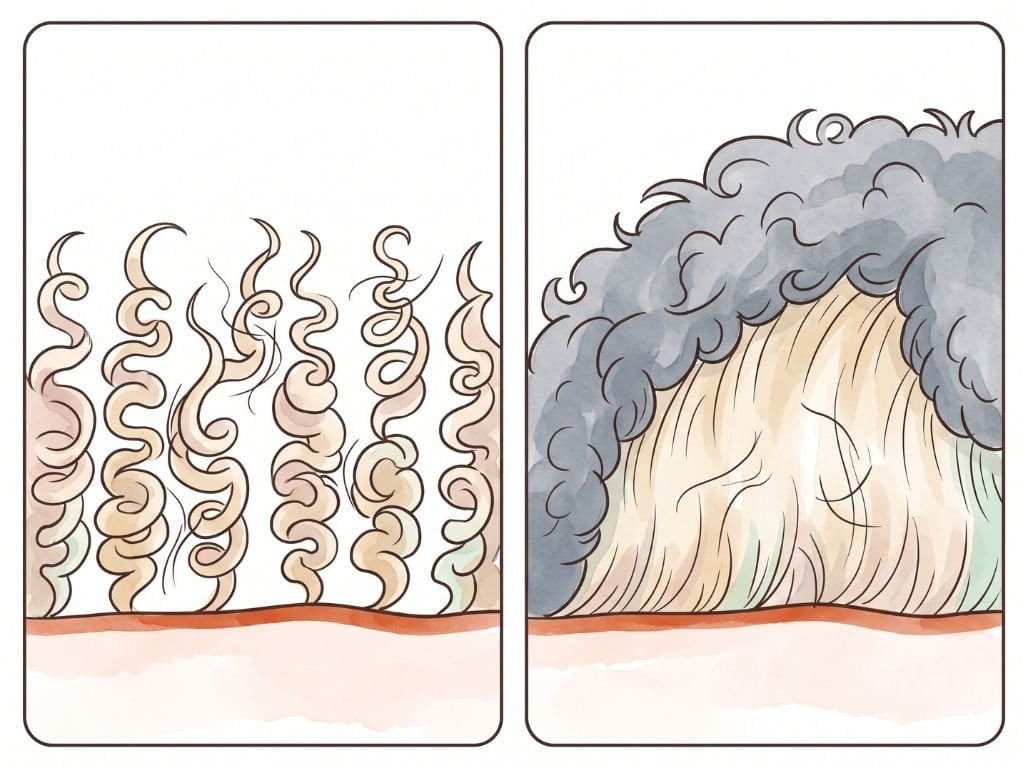
Both coats hold shed hair instead of dropping it, which is the part that matters on your sofa. The difference is where it collects. A single curly coat leaves a comb a clear path to the skin, while a double coat packs a soft under-layer against it, and that is the layer that felts into a solid mat when a week gets skipped.
Toy poodle vs bichon frise size: which is smaller?
The Toy Poodle, by a clear margin.
A Toy Poodle stands up to 10 inches and usually weighs 4 to 6 pounds. A Bichon Frise stands 9.5 to 11.5 inches and weighs 12 to 18 pounds, so a typical Bichon is two to three times the Toy Poodle’s weight despite being a similar height. The Bichon is a stocky little dog under all that coat.
If you are picturing a lap dog you can carry through an airport, only one of these is that dog.
| Standard | Toy Poodle | Miniature Poodle | Bichon Frise |
|---|---|---|---|
| Height | Up to 10 inches | 10 to 15 inches | 9.5 to 11.5 inches |
| Weight | 4 to 6 lb | 10 to 15 lb | 12 to 18 lb |
| Build | Fine-boned, delicate | Light, athletic | Sturdy and compact |
| Typical lifespan | 10 to 18 years | 10 to 18 years | 14 to 15 years |
| Watch for | Luxating patella, dental issues | Luxating patella, eye disease | Allergies and skin issues, bladder stones |
None of this changes the allergy math. A smaller dog is less total dog, not a lower-allergen animal, and the small hypoallergenic dogs guide goes through why size is the wrong lever to pull.
There is one size-related catch worth knowing. The Bichon is genuinely prone to skin problems of its own, and irritated flaky dog skin produces more dander, so a Bichon with an untreated skin condition is a worse allergy proposition than a healthy one.
Bichon frise vs mini poodle: which one should you pick?
The Mini Poodle if you want a thinking dog, the Bichon if you want a calm one.
At 10 to 15 pounds the Miniature Poodle is the closest size match to a Bichon, which makes this the comparison most buyers actually face. Temperament is where they separate. The Mini Poodle is one of the most trainable dogs there is and needs the mental work to match; the Bichon is softer, sillier, and content with less.
Think about your evenings, not your weekends. A bored Poodle will find a job in your house whether you assigned one or not.
The Bichon’s honest catch is the flip side of that easy temperament. Bichons attach hard and are prone to separation anxiety, so an empty house from morning to evening suits neither breed, but suits the Bichon least.
If you forced me to choose for a first-time owner with allergies, I would take the Bichon.
The reasoning is not allergy science, because on that they are level. It is that a Bichon’s needs are easier to meet consistently, and consistency is what keeps a grooming and bathing routine alive past month three. A routine you actually keep beats a marginally better breed on paper.
Common mistakes
- Assuming the Poodle is the safer allergy pick. It is the better-documented low shedder and it measured near the top for coat allergen. Reputation and measurement point different directions here.
- Reading “both are hypoallergenic” as settled. Every ranking comparison says it and none of them cites a measurement. Both breeds are low-allergen by listing, not by proof.
- Underestimating the grooming bill. Every 4 to 6 weeks at a groomer, for the life of the dog. Skipping it produces mats, and mats hold dander you cannot wash out.
- Buying a Bichon with visible skin trouble. Flaky, irritated skin makes more dander. Ask about skin history and look at the parents.
- Choosing a Toy Poodle for a house with small children. At 4 to 6 pounds it is genuinely fragile. The Bichon is the sturdier family dog.
- Skipping the exposure visit. Two dogs of one breed vary more than these two breeds do. Sit with the actual adult dog, twice, before deciding.
FAQ
Is a Poodle or a Bichon Frise better for allergy sufferers?
Neither, on the current evidence. Both carry the AKC low-allergen listing and no study has compared them directly. In fact the one study that measured coat allergen by breed put Poodles near the top of the range. Choose on grooming commitment and temperament, then test your own reaction with the specific adult dog.
Which sheds more, a Bichon Frise or a Poodle?
Both shed very little, and the difference is not something you would notice at home. The Poodle has a single curly coat and the Bichon a curly double coat, so both hold loose hair in the curl rather than dropping it. You collect that hair with a brush instead of a vacuum.
Is a Bichon Frise calmer than a Poodle?
Generally yes. Bichons are softer, steadier, and content with moderate activity and company. Poodles are highly intelligent and need real mental work, and a bored Poodle finds its own entertainment. Neither copes well with long days alone, but the Bichon is the more prone to separation anxiety.
Which is smaller, a Toy Poodle or a Bichon Frise?
The Toy Poodle, by a lot in weight. A Toy Poodle is 4 to 6 pounds and a Bichon Frise is 12 to 18 pounds, even though their heights are similar at around 10 inches. The Bichon is a stocky, sturdy little dog under its coat, which makes it the better fit for a house with children.
Do Poodles and Bichon Frises need the same grooming?
Almost. Both need professional grooming every 4 to 6 weeks and brushing to the skin most days. The Bichon’s undercoat mats slightly faster, so it needs the more careful line-brushing. For allergy control, both benefit from far more frequent bathing than coat health alone would require.
Sources
Sources (8)SourcesShow sourcesHide sources
- Vredegoor DW, Willemse T, Chapman MD, Heederik DJJ, Krop EJM. Can f 1 levels in hair and homes of different dog breeds: lack of evidence to describe any dog breed as hypoallergenic. Journal of Allergy and Clinical Immunology. 2012;130(4):904-909. https://pubmed.ncbi.nlm.nih.gov/22728082/
- Ramadour M, Guetat M, Guetat J, El Biaze M, Magnan A, Vervloet D. Dog factor differences in Can f 1 allergen production. Allergy. 2005;60(8):1060-1064. https://pubmed.ncbi.nlm.nih.gov/15969688/
- Hodson T, Custovic A, Simpson A, Chapman M, Woodcock A, Green R. Washing the dog reduces dog allergen levels, but the dog needs to be washed twice a week. Journal of Allergy and Clinical Immunology. 1999;103(4):581-585. https://pubmed.ncbi.nlm.nih.gov/10200004/
- Cadieu E, Neff MW, Quignon P, et al. Coat variation in the domestic dog is governed by variants in three genes. Science. 2009;326(5949):150-153. https://pubmed.ncbi.nlm.nih.gov/19713490/
- Konieczny A, Morgenstern JP, Bizinkauskas CB, et al. The major dog allergens, Can f 1 and Can f 2, are salivary lipocalin proteins: cloning and immunological characterization of the recombinant forms. Immunology. 1997;92(4):577-586. https://pubmed.ncbi.nlm.nih.gov/9497502/
- Nicholas CE, Wegienka GR, Havstad SL, Zoratti EM, Ownby DR, Johnson CC. Dog allergen levels in homes with hypoallergenic compared with nonhypoallergenic dogs. American Journal of Rhinology & Allergy. 2011;25(4):252-256. https://pubmed.ncbi.nlm.nih.gov/21819763/
- American Kennel Club. Official standard of the Poodle. https://images.akc.org/pdf/breeds/standards/Poodle.pdf
- American Kennel Club. Official standard of the Bichon Frise. https://images.akc.org/pdf/breeds/standards/BichonFrise.pdf
Related guides
- Maltese vs Yorkie: dander, shedding, and allergy odds. The comparison hub, and the pair where the labels actually differ.
- Are Bichon Frises hypoallergenic?. The Bichon on its own, grade and limits.
- Small hypoallergenic dogs: the honest low-dander guide. Where both breeds land against the wider small-breed set.
Where I land, after reading everything: this pair is a coin toss on allergy and a real choice on lifestyle. Pick the temperament you can live with for fifteen years, commit to the grooming, and test yourself against the actual dog before you sign anything.
Which one are you leaning toward, and have you priced up the grooming yet?
— Adrian V.