
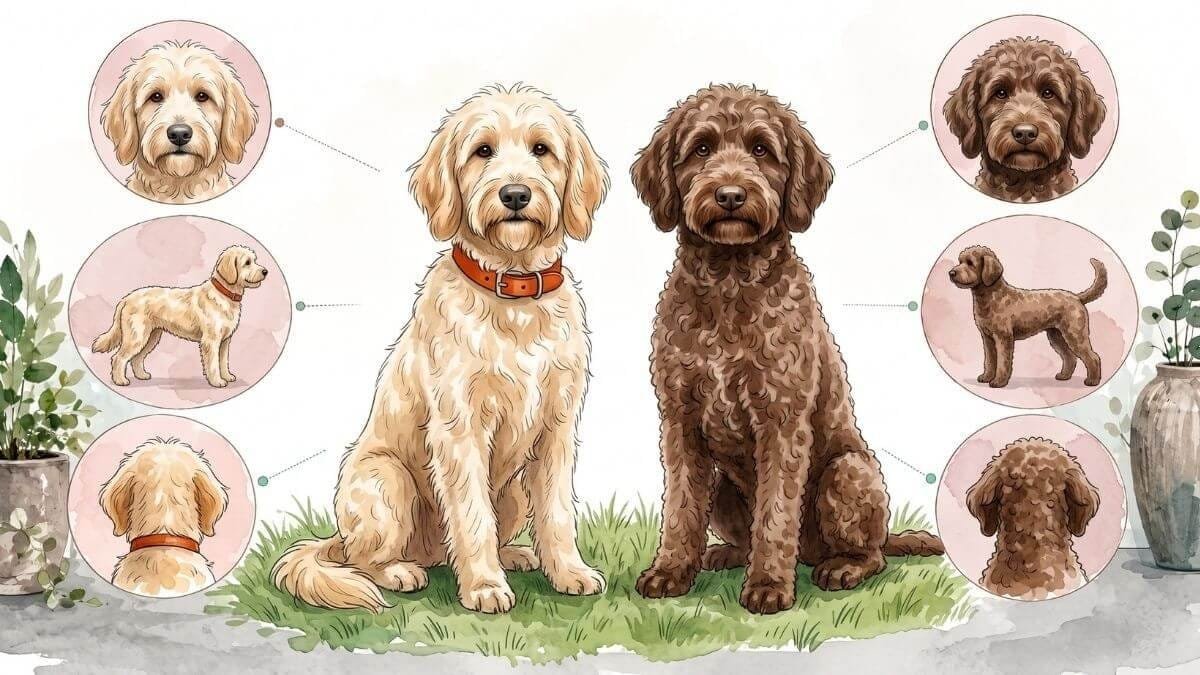
The honest goldendoodle vs labradoodle difference comes down to which retriever is in the mix, and that matters less than almost every page selling you one suggests. A Goldendoodle is a Golden Retriever crossed with a Poodle. A Labradoodle is a Labrador crossed with a Poodle.
Everything else people tell you about the two, the coat, the shedding, the allergy promise, varies more inside each cross than between them.
That is the finding, and it is not what you will read on a breeder’s site. If you want the comparison hub first, it is maltese vs yorkie, where the two breeds actually do carry different labels.
The short version
| Goldendoodle | Labradoodle | |
|---|---|---|
| Cross | Golden Retriever x Poodle | Labrador Retriever x Poodle |
| Honest label | Designer hybrid | Designer hybrid |
| Typical coat | Softer, wavier, often shaggier | Often tighter and denser |
| Temperament lean | Softer, more openly social | More athletic drive, more focus |
| Allergy verdict | Neither is a guarantee. Coat and allergen output are a genetic lottery in both. | |
Who this is for: you want a doodle, someone at home reacts to dogs, and you are trying to work out which cross gives better odds. Read this before you pay a deposit, because deposits are where the pressure starts.
If anyone in the house has asthma or a history of strong reactions, no doodle clears them. That needs an allergist and a supervised visit with adult dogs, not a puppy cuddle.
Key takeaways
- Both are designer hybrids, not breeds. Neither has a settled coat you can count on.
- The parent retriever is the only reliable difference. Goldens bring a softer wavier coat and a softer temperament, Labs bring more drive.
- Coat type comes down to a handful of genes, and a cross puppy can inherit either parent’s version. At eight weeks you cannot tell which.
- Researchers measured coat allergen in Labradoodles directly and found no support for calling them hypoallergenic.
- A genome study found the Australian Labradoodle is mostly Poodle by ancestry, selected hard for the poodle coat because breeders believe it means hypoallergenic.
- Doodles are not measurably healthier than their parent breeds either. The hybrid vigour story does not hold up.
Goldendoodle vs labradoodle allergies: does either one solve them?
No.
Neither cross is a reliable answer to a dog allergy, and this is the single most oversold claim in the doodle market. Both carry Poodle ancestry, which is where the low-shedding reputation comes from, and both can produce a puppy that sheds and one that does not from the same litter. The allergy outcome is not decided by which retriever is involved.
Picture the moment this actually matters. You are in a breeder’s kitchen, the puppy is asleep on your foot, and nobody in the room has sneezed once. That proves very little about the dog it becomes.
The measurement that should be famous and is not comes from a 2012 study in the Journal of Allergy and Clinical Immunology. Researchers tested Can f 1, the main protein from a dog’s skin and saliva that people react to, in breeds marketed as hypoallergenic, and Labradoodles were one of the groups they sampled. The marketed dogs carried more allergen in their coats than the ordinary comparison breeds, and homes with them were no cleaner.
That study named the Labradoodle specifically. It is the closest thing to a direct test of the doodle promise that exists, and it came back negative.
There is a second finding that explains why the promise persists. A 2020 genome study in PLoS Genetics analysed the modern Australian Labradoodle and found it is predominantly Poodle by ancestry, enriched for the variants that produce a poodle-like coat, which the authors note breeders perceive as linked to hypoallergenicity.
Read that again. The breed was selected toward the Poodle coat because of a belief about allergies, not because of a measurement.
So the doodle is a dog bred to look like the answer.
Labradoodle vs goldendoodle shedding: which sheds less?
Neither, reliably.
Individual dogs vary far more than the two crosses do. A doodle with a tight curly coat usually sheds very little, and a doodle with a flat or straight coat can shed like the retriever half of its family. Both crosses produce both.
That is why blanket statements about doodle shedding are worth nothing without seeing the specific adult dog.
The genetics here are unusually clean, and knowing them protects you from a lot of sales talk. A 2009 study in Science showed that three genes account for nearly all coat variation in dogs: one for length, one for curl, and one for the wiry furnished look that gives doodles their beard and eyebrows.
A purebred Poodle carries two curly copies of that gene. A retriever carries none.
A first cross gets one of each, so the litter is a shuffle rather than an average.
| Coat you might get | Sheds | Grooming | Odds for an allergy home |
|---|---|---|---|
| Curly, poodle-like | Very little | Heaviest, mats fast | Best of the three, still not a guarantee |
| Wavy or fleece | Light | Moderate to heavy | Middling, and the most common outcome |
| Straight or flat | Like a retriever | Lightest | Poor. This is the coat buyers are not warned about. |
The Labradoodle does lean tighter and the Goldendoodle softer and wavier, on average. An average is not a promise about the puppy in front of you, and the coat a doodle puppy has at eight weeks is often not the coat it has at eighteen months.
If the generation labels are what you are really asking about, that question has its own page: f1 vs f1b goldendoodle covers what the percentages do and do not buy you.
Whatever coat you end up with, washing is the lever with evidence behind it. A 1999 study in the Journal of Allergy and Clinical Immunology found a wash cut recoverable coat allergen by about 84 percent, with levels back to baseline in roughly three days.
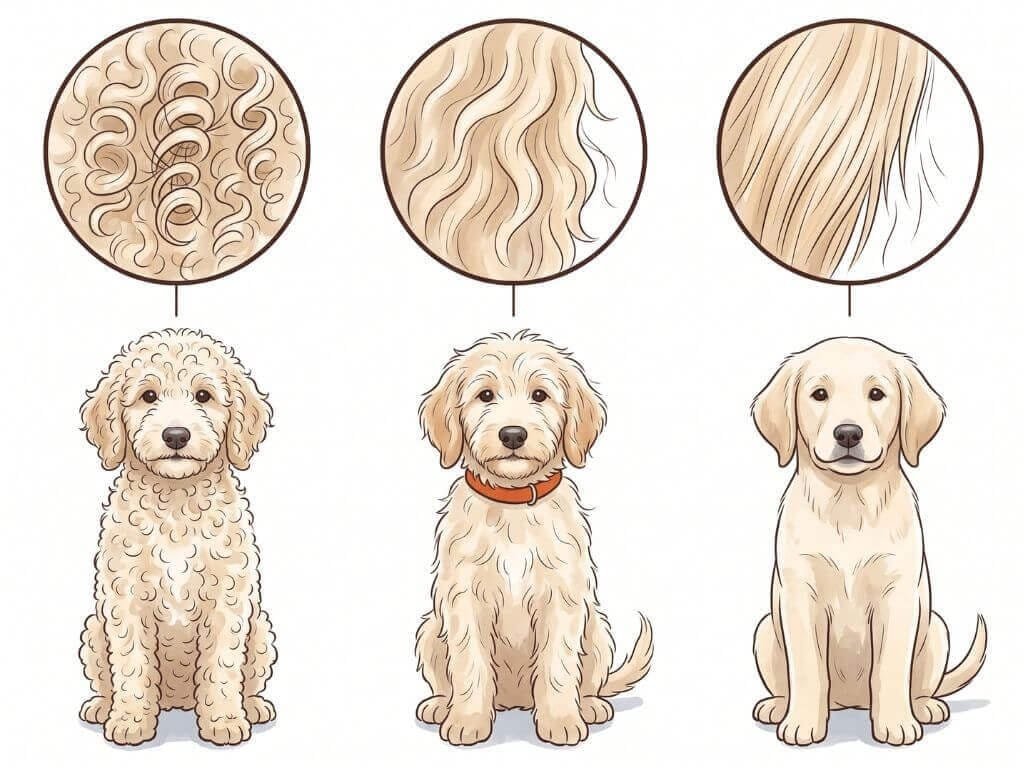
One litter, three possible coats, and both crosses produce all three. The curly coat holds shed hair until you brush it out, the wavy coat is the common middle, and the flat coat drops hair like the retriever half of the family. This is the spread no generation label removes, it only narrows the odds.
Mini goldendoodle vs mini labradoodle: does going smaller help?
Not for allergies, no.
Both minis are made by crossing the retriever line back to a Miniature or Toy Poodle, which brings the adult weight down to roughly 15 to 35 pounds. Smaller dog, same proteins. What you gain is a dog that fits an apartment and costs less to feed, not one that is easier on your immune system.
There is a real trade you should know about before the size sells you.
Adding more Poodle to shrink the dog also adds more Poodle temperament, which means more intelligence, more energy per pound, and more need for mental work. Mini doodles are frequently more demanding than their full-size versions, not less, and buyers who chose small for a quiet life are often surprised.
The health story is worth a mention too, since hybrid vigour is usually the second thing a breeder tells you. A 2024 study in PLOS ONE compared owner-reported disorders across 9,402 dogs and found no significant difference from the parent breeds in about 87 percent of comparisons, with Labradoodles higher on some conditions and lower on others.
Crossing two breeds gets you a different dog, not a healthier one.
Goldendoodle vs labradoodle pros and cons
Here is the trade-off table I wish someone had handed me, with the honest cons included rather than buried.
| Goldendoodle | Labradoodle | |
|---|---|---|
| Pros | Softer and more openly friendly, usually easier with strangers and children, wavier coat that many find easier to live with | More biddable working drive, often a tighter coat, the Australian lines have the most consistent coat of any doodle |
| Cons | Coat varies widely, can inherit a shedding retriever coat, high grooming cost, prone to separation anxiety | Higher energy needs a real outlet, can be boisterous as a young dog, same coat lottery outside the multigen lines |
| Grooming | Every 6 to 8 weeks professionally, brushing several times a week, more if the coat is curly | |
| Typical adult weight | 50 to 90 lb standard, 15 to 35 lb mini | 50 to 65 lb standard, 15 to 35 lb mini |
| Allergy odds | Equivalent. Decided by the individual dog’s coat and your own reaction, not by the cross. | |
If you want the wider picture on why no breed earns the label, the hypoallergenic dogs guide has the full breakdown.
How do you actually buy a doodle if you have allergies?
You test against adult dogs from the same lines, not the puppy.
A puppy has barely started producing what you react to, and its coat has not settled. The only meaningful test is unhurried time with grown dogs from the same breeding, ideally in their own homes, long enough for a reaction to show. Two hours beats two minutes.
- See an allergist first if reactions have ever been serious. Ask about component testing, and specifically whether you react to Can f 5, the male-dog protein, because that answer can change everything.
- Ask the breeder to see both parents and, if possible, adult dogs from previous litters. You are trying to see the coat outcome, not the puppy.
- Push into real exposure during the visit. Let the dog lick your hand, then touch your face. Sit where its dander settles. A polite meet-and-greet hides what you need to know.
- Get a written return agreement before any money moves. Ask directly what happens if someone in the house reacts.
- Treat any breeder who says their dogs are hypoallergenic as a warning sign. It is a claim no honest seller can make.
That last one is the cheapest filter on this page, and it removes a lot of sellers.
Common mistakes
- Believing the cross decides the allergy outcome. It does not. The individual dog’s coat does, and both crosses produce every coat type.
- Taking “hypoallergenic” from a breeder at face value. Researchers measured Labradoodle coats directly and found no support for it. Anyone still selling the claim is selling, not informing.
- Judging the coat at eight weeks. Doodle coats change substantially through the first eighteen months. The puppy fluff is not the adult coat.
- Assuming a mini is easier. More Poodle means more brain and more energy per pound. Mini doodles are often the more demanding dog.
- Expecting hybrid vigour. A large owner survey found doodles no healthier than their parent breeds across the great majority of conditions.
- Underestimating grooming. A curly doodle mats fast, and a matted coat holds dander you cannot wash out. Budget every 6 to 8 weeks, for life.
FAQ
What is the main difference between a Goldendoodle and a Labradoodle?
The parent retriever. A Goldendoodle is a Golden Retriever crossed with a Poodle, a Labradoodle is a Labrador crossed with a Poodle. In practice Goldendoodles lean softer and wavier in both coat and temperament, and Labradoodles lean tighter-coated and more athletic. Both vary more within the cross than between them.
Which is better for allergies, a Goldendoodle or a Labradoodle?
Neither reliably. Both are designer hybrids whose coat and allergen output are inherited unpredictably, so one litter can produce a low shedder and a shedder. Researchers who measured coat allergen in Labradoodles found no evidence supporting the hypoallergenic label. Test your own reaction against adult dogs from the same lines before committing.
Do Goldendoodles or Labradoodles shed more?
It depends on the individual dog, not the cross. A curly poodle-like coat sheds very little, a wavy fleece coat sheds lightly, and a flat retriever-like coat sheds properly. Both Goldendoodles and Labradoodles produce all three, which is why seeing the adult dog matters more than the name.
Is a mini Goldendoodle better than a mini Labradoodle for a small home?
They are close, and size is the wrong thing to decide on. Both minis run roughly 15 to 35 pounds and both carry extra Poodle, which usually means more intelligence and more energy per pound rather than less. Choose on temperament and the individual dog’s coat, and remember a smaller dog is not a lower-allergen dog.
Are doodles healthier than purebred dogs?
The evidence says no. A 2024 owner survey of more than 9,000 dogs compared Labradoodles, Cockapoos and Cavapoos with their parent breeds and found no significant difference in about 87 percent of the health comparisons made. Crossbreeding produced a different dog, not a measurably healthier one.
Sources
Sources (9)SourcesShow sourcesHide sources
- Vredegoor DW, Willemse T, Chapman MD, Heederik DJJ, Krop EJM. Can f 1 levels in hair and homes of different dog breeds: lack of evidence to describe any dog breed as hypoallergenic. Journal of Allergy and Clinical Immunology. 2012;130(4):904-909. https://pubmed.ncbi.nlm.nih.gov/22728082/
- Ali MB, Evans JM, Parker HG, et al. Genetic analysis of the modern Australian labradoodle dog breed reveals an excess of the poodle genome. PLoS Genetics. 2020;16(9):e1008956. https://pubmed.ncbi.nlm.nih.gov/32911491/
- Cadieu E, Neff MW, Quignon P, et al. Coat variation in the domestic dog is governed by variants in three genes. Science. 2009;326(5949):150-153. https://pubmed.ncbi.nlm.nih.gov/19713490/
- Bryson GT, O’Neill DG, Brand CL, Belshaw Z, Packer RMA. The doodle dilemma: how the physical health of designer-crossbreed Cockapoo, Labradoodle and Cavapoo dogs compares to their purebred progenitor breeds. PLOS ONE. 2024;19(8):e0306350. https://pubmed.ncbi.nlm.nih.gov/39196904/
- Ramadour M, Guetat M, Guetat J, El Biaze M, Magnan A, Vervloet D. Dog factor differences in Can f 1 allergen production. Allergy. 2005;60(8):1060-1064. https://pubmed.ncbi.nlm.nih.gov/15969688/
- Hodson T, Custovic A, Simpson A, Chapman M, Woodcock A, Green R. Washing the dog reduces dog allergen levels, but the dog needs to be washed twice a week. Journal of Allergy and Clinical Immunology. 1999;103(4):581-585. https://pubmed.ncbi.nlm.nih.gov/10200004/
- American Kennel Club. Official standard of the Poodle. https://images.akc.org/pdf/breeds/standards/Poodle.pdf
- American Kennel Club. Official standard of the Golden Retriever. https://images.akc.org/pdf/breeds/standards/GoldenRetriever.pdf
- American Kennel Club. Official standard of the Labrador Retriever. https://images.akc.org/pdf/breeds/standards/LabradorRetriever.pdf
Related guides
- Maltese vs Yorkie: dander, shedding, and allergy odds. The comparison hub for this silo.
- F1 vs F1B Goldendoodle shedding. What the generation percentages actually buy you.
- Hypoallergenic dogs: what the science actually says. Why no breed or cross earns the label.
My honest read, after going through the genetics and the allergen work: the goldendoodle vs labradoodle question is far less important than the question of which individual dog you bring home. Pick the temperament you want, then judge the coat on an adult, then test yourself against that specific dog.
Are you set on a doodle, or still weighing a purebred low-shedder against one?
— Adrian V.