
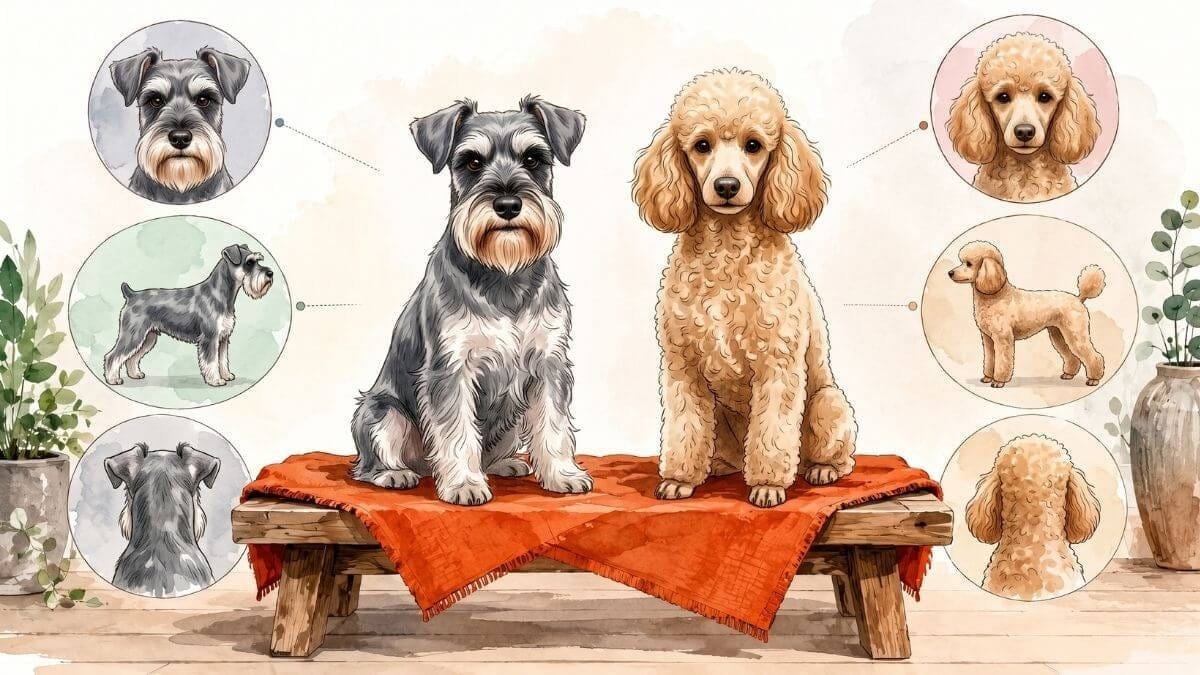
The Miniature Schnauzer and the Toy or Miniature Poodle are both on the American Kennel Club’s low-allergen list, and both turn up on every shortlist an allergy family is handed. What almost nobody explains is that their coats work differently, and the difference matters more than the label.
One has a wiry double coat. The other has a curly single coat. Those two things hold dander in different ways and release it under different conditions.
I will also flag something awkward early, because it is the most useful thing on this page: the Poodle is the breed with the most allergy goodwill and the least flattering measurement. The comparison hub for this silo is maltese vs yorkie if you want the wider set first.
The short version
| Miniature Schnauzer | Toy / Miniature Poodle | |
|---|---|---|
| Honest label | AKC low-allergen | AKC low-allergen |
| Coat | Wiry double coat | Curly single coat |
| Sheds | Very little | Very little |
| Dander handling | Traps it in the undercoat | Traps it in the curl |
| Temperament | Alert, bold, more terrier | Highly intelligent, needs a job |
Who this is for: you have narrowed a small low-shedding dog to these two and someone at home reacts to dogs. Read it before a deposit.
Asthma or any history of a strong reaction puts both breeds out of reach of a blog post. See an allergist and arrange a supervised visit with adult dogs first.
Key takeaways
- Both are AKC low-allergen and both shed very little. On the label this is a tie.
- The Poodle measured the highest of eight breeds for coat allergen in the one study that put numbers on it.
- A high coat reading means allergen held in the coat, not thrown into your rooms. That is an argument for washing, not for avoiding.
- The Schnauzer’s wiry double coat traps dander in the undercoat. Clipping softens that coat over time and changes how it behaves.
- The Schnauzer’s beard is a genuine allergy factor. It collects saliva, food, and water all day.
- Neither breed is low-maintenance, and the grooming routine matters more than which one you pick.
Schnauzer vs poodle allergies: which one is better?
Neither, and the Poodle’s reputation is doing work its data does not support.
Both breeds sit on the AKC low-allergen list and both have coats that hold shed hair rather than dropping it. No study has compared them head to head. What exists is one breed-level measurement, and it is not kind to the more famous of the two.
A 2005 study in the journal Allergy measured Can f 1, the main protein from a dog’s skin and saliva that people react to, on the fur of 288 dogs across eight breeds. The Poodle averaged 17.04 micrograms per gram, the highest group in the study, against a Labrador Retriever’s 1.99.
The Schnauzer was not in that study, so we have a number for one of these breeds and nothing for the other.
That asymmetry is worth sitting with rather than resolving. It does not mean the Schnauzer is cleaner; it means nobody has checked.
The Poodle number also needs reading correctly, because it is easy to misuse. Allergen measured in a coat is allergen the coat is holding, and a dense curly coat is very good at holding things. The same study found homes with these breeds were not measurably worse, which fits: the coat is acting like a filter.
A filter still needs emptying. That is what the bathing schedule is for.
The Schnauzer vs Poodle scorecard
Both grade B in the site’s small-breed matrix, so here is where they actually separate.
| Decision vector | Mini Schnauzer | Toy / Mini Poodle | The honest note |
|---|---|---|---|
| Allergen confidence | B | B | Both AKC low-allergen. The Poodle has a number and it is high; the Schnauzer has none. |
| Loose hair in the home | B | B | A genuine tie. Both hold shed hair in the coat until it is combed out. |
| Dander held in the coat | C | B | The Schnauzer’s undercoat holds more near the skin, so a missed groom releases more at once. |
| Saliva spread | C | B | The beard. It stays damp and it touches everything, including you. |
| Coat predictability | B | B | Both settled purebred coats. You know what the adult dog becomes, unlike any doodle cross. |
| Calm in the house | C | C | Different problems, same score. The Schnauzer barks; the Poodle invents work if you give it none. |
The beard row is the one I would not have predicted before writing this page, and it is the closest thing to a real allergy differentiator between the two.
Schnauzer vs poodle shedding: wiry coat versus curly coat
Both shed very little, and they hold what they shed in different places.
The Miniature Schnauzer has a double coat: a harsh wiry outer coat over a soft undercoat. The Poodle has a single curly coat with no undercoat at all. Both trap loose hair rather than dropping it, which is why neither breed leaves hair on your furniture.
Coat texture is not a mystery, incidentally. A 2009 study in Science traced almost all coat variation in dogs to three genes covering length, curl, and the wiry furnished look. The Schnauzer’s wire and the Poodle’s curl come from different combinations, which is exactly why the two coats behave differently in a house.
| Coat trait | Mini Schnauzer | Toy / Mini Poodle | What it means for you |
|---|---|---|---|
| Structure | Wiry outer coat, soft undercoat | Curly single coat | The Schnauzer holds more dander against the skin |
| Where dander sits | In the undercoat | Through the curl | The Poodle’s is easier to reach with a bath |
| Matting | Moderate, worst on the legs and beard | Fast, all over | Mats hold dander a bath cannot wash through |
| Brushing | Two or three times a week | Most days | The Poodle is the bigger daily commitment |
| Professional groom | Every 5 to 8 weeks | Every 4 to 6 weeks | Budget for it on both, for the life of the dog |
| Bathing, allergen control | Closer to twice a week if the skin tolerates it | Coat allergen returns to baseline in about three days | |
That last row is the only number on this page with strong evidence behind it. A 1999 study in the Journal of Allergy and Clinical Immunology found a wash cut recoverable coat allergen by about 84 percent, with levels back at baseline within three days.
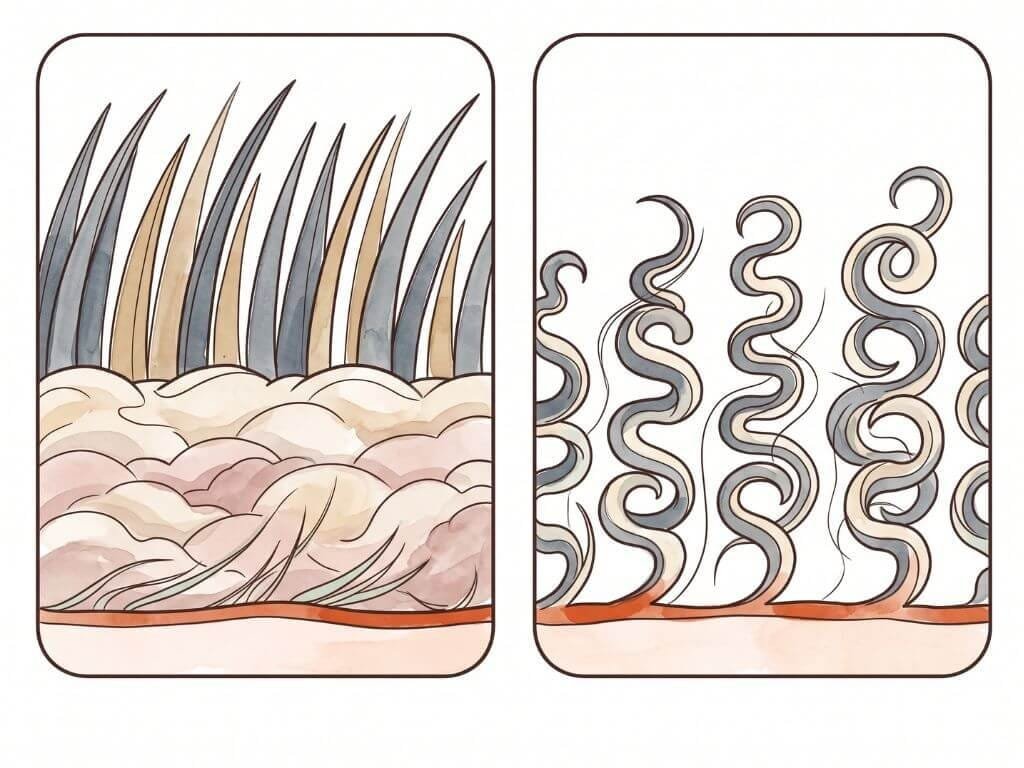
Neither coat drops much on your furniture, which is the claim both breeds are sold on and it holds. They part company underneath. The wire coat traps what it sheds in the soft undercoat pressed against the skin, while the curly coat holds it out in the curl where a comb can reach it. That is a grooming difference, not an allergen one.
Hand-stripping versus clipping, and why it matters here
Most pet Schnauzers get clipped, and clipping quietly changes the coat.
A wire coat is meant to be hand-stripped, which means pulling the dead outer hairs out at the root so a new harsh coat grows in. Clipping cuts those hairs instead, and over a few years the outer coat grows back softer and the undercoat thickens. A softer, denser coat traps more dander closer to the skin than the harsh coat it replaced.
None of that makes a clipped Schnauzer a bad allergy dog. It does mean the coat you assess at two years is not the coat the breed standard describes, and it needs more thorough combing than owners expect. The dedicated page on whether are miniature schnauzers hypoallergenic goes further into that trade.
Schnauzer vs poodle differences: size, temperament, and health
The Poodle is the more trainable dog, the Schnauzer the more opinionated one.
A Miniature Schnauzer stands 12 to 14 inches and weighs 11 to 20 pounds. A Toy Poodle is up to 10 inches and 4 to 6 pounds; a Miniature Poodle is 10 to 15 inches and 10 to 15 pounds. So a Mini Poodle is the size match, and a Toy Poodle is a much smaller and more fragile animal.
| Standard | Mini Schnauzer | Toy Poodle | Mini Poodle |
|---|---|---|---|
| Height | 12 to 14 inches | Up to 10 inches | 10 to 15 inches |
| Weight | 11 to 20 lb | 4 to 6 lb | 10 to 15 lb |
| Typical lifespan | 12 to 15 years | 10 to 18 years | 10 to 18 years |
| Temperament | Alert, bold, vocal, loyal | Very intelligent, sensitive, needs mental work | |
| Watch for | Pancreatitis, high blood fats, skin bumps | Luxating patella, eye disease, dental issues | |
One Schnauzer-specific health note is directly relevant to allergies. The breed is prone to comedones, small blocked follicles along the back sometimes called schnauzer bumps, and to skin problems generally. Irritated flaky skin produces more dander, so a Schnauzer with an untreated skin condition is a worse allergy proposition than a healthy one.
Buy the healthy-skinned dog, whichever breed you land on.
Poodle mix vs schnauzer mix: is a Schnoodle a shortcut?
No, a cross makes the coat less predictable, not more.
A Schnoodle is a Schnauzer crossed with a Poodle, and a first-generation puppy can inherit either parent’s coat type or something between. Both parents are low-shedding, which improves the odds compared with crossing to a retriever, but you are still trading a settled adult coat for a guess.
The purebred advantage in this pair is unusually strong. Both the Schnauzer and the Poodle have coats you can predict from the parents, and neither cross does better than that.
If someone offers you a Schnoodle at a premium because it is more hypoallergenic than either parent, that is a claim with nothing behind it.
Common mistakes
- Assuming the Poodle is the safer pick. It has the best reputation and the highest measured coat allergen of eight breeds tested. Reputation is not evidence.
- Reading a high coat measurement as a reason to avoid. Allergen held in a coat is allergen not in your air. Wash the dog rather than skip the breed.
- Ignoring the beard. A Schnauzer’s beard stays damp with saliva and food all day, and it touches your hands, your clothes, and your furniture.
- Clipping a wire coat for years and expecting no change. The coat softens and the undercoat thickens, which changes how it holds dander and how much combing it needs.
- Buying a Schnauzer with visible skin trouble. Flaky irritated skin makes more dander, and this breed is prone to skin problems.
- Choosing a Toy Poodle for a house with young children. At 4 to 6 pounds it is genuinely fragile. The Mini Schnauzer is the sturdier family dog.
FAQ
Is a Schnauzer or a Poodle better for allergies?
Neither has a proven edge. Both are AKC low-allergen breeds that shed very little, and they have never been compared directly. The one study measuring coat allergen by breed put the Poodle highest of the eight tested, while the Schnauzer was not measured at all. Test your own reaction against the specific adult dog.
Do Miniature Schnauzers shed less than Poodles?
They are about equal, and neither drops much hair. The Schnauzer has a wiry double coat and the Poodle a curly single coat, and both hold shed hair in the coat until it is brushed out. The difference is where dander collects, not how much hair lands on your floor.
Does a Schnauzer’s beard affect allergies?
Yes, more than most people expect. The beard collects saliva, food, and water throughout the day and stays damp, and dried saliva carries the main dog allergen. It also touches hands, clothes, and furniture constantly, so wiping it daily is a genuinely useful habit in an allergy household.
Is a Schnoodle more hypoallergenic than a Schnauzer or a Poodle?
No. A Schnoodle is a cross whose coat can follow either parent, so it is less predictable than either purebred rather than better. Both parent breeds are low-shedding, which helps the odds, but no cross is measurably lower in allergen. Judge the individual dog rather than the label.
Does clipping a Schnauzer instead of hand-stripping change anything?
Yes, over time. Clipping cuts the harsh outer hairs rather than removing them at the root, so the coat gradually grows in softer and the undercoat thickens. A softer denser coat traps more dander close to the skin, which means a clipped Schnauzer needs more thorough combing than the breed standard would suggest.
Sources
Sources (7)SourcesShow sourcesHide sources
- Ramadour M, Guetat M, Guetat J, El Biaze M, Magnan A, Vervloet D. Dog factor differences in Can f 1 allergen production. Allergy. 2005;60(8):1060-1064. https://pubmed.ncbi.nlm.nih.gov/15969688/
- Vredegoor DW, Willemse T, Chapman MD, Heederik DJJ, Krop EJM. Can f 1 levels in hair and homes of different dog breeds: lack of evidence to describe any dog breed as hypoallergenic. Journal of Allergy and Clinical Immunology. 2012;130(4):904-909. https://pubmed.ncbi.nlm.nih.gov/22728082/
- Hodson T, Custovic A, Simpson A, Chapman M, Woodcock A, Green R. Washing the dog reduces dog allergen levels, but the dog needs to be washed twice a week. Journal of Allergy and Clinical Immunology. 1999;103(4):581-585. https://pubmed.ncbi.nlm.nih.gov/10200004/
- Cadieu E, Neff MW, Quignon P, et al. Coat variation in the domestic dog is governed by variants in three genes. Science. 2009;326(5949):150-153. https://pubmed.ncbi.nlm.nih.gov/19713490/
- Konieczny A, Morgenstern JP, Bizinkauskas CB, et al. The major dog allergens, Can f 1 and Can f 2, are salivary lipocalin proteins: cloning and immunological characterization of the recombinant forms. Immunology. 1997;92(4):577-586. https://pubmed.ncbi.nlm.nih.gov/9497502/
- American Kennel Club. Official standard of the Miniature Schnauzer. https://images.akc.org/pdf/breeds/standards/MiniatureSchnauzer.pdf
- American Kennel Club. Official standard of the Poodle. https://images.akc.org/pdf/breeds/standards/Poodle.pdf
Related guides
- Maltese vs Yorkie: dander, shedding, and allergy odds. The comparison hub for this silo.
- Are Miniature Schnauzers hypoallergenic?. The Schnauzer on its own, including hand-stripping versus clipping.
- Small hypoallergenic dogs: the honest low-dander guide. Where both breeds land against the wider small-breed set.
Where I land: this pair is close enough on allergy that I would decide on temperament and grooming appetite. The Poodle asks for mental work and daily brushing, the Schnauzer asks for bark management and a beard routine. Pick the chore you will still be doing in year five.
Which one fits your household better, and have you spent an afternoon with an adult of either breed yet?
— Adrian V.