
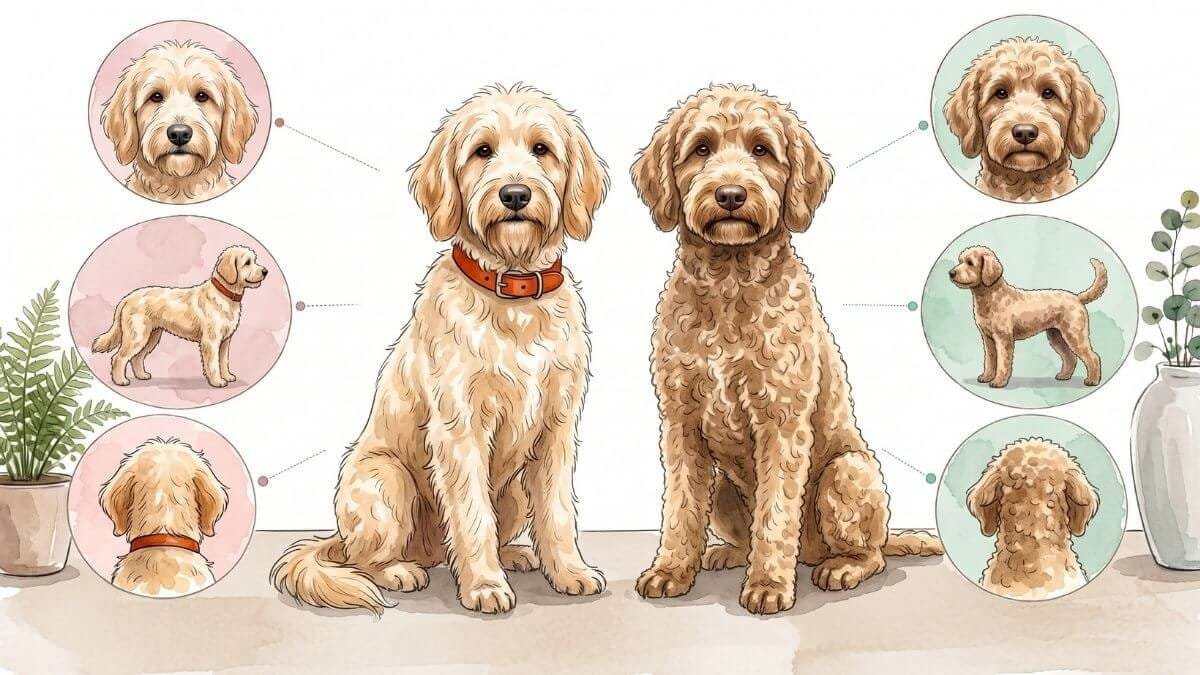
An F1 Goldendoodle is half Golden Retriever, half Poodle. An F1B is that dog bred back to a Poodle, so roughly a quarter Golden and three quarters Poodle. Breeders usually charge more for the F1B, and the reason they give is allergies.
The odds part of that is true. The promise part is not.
More Poodle really does raise the chance of a low-shedding curly coat. It does not convert a probability into a guarantee, and the gap between those two things is where a lot of money and a few returned dogs live. For the wider pair comparison, see goldendoodle vs labradoodle, and the hub for this silo is maltese vs yorkie.
The short version
| F1 Goldendoodle | F1B Goldendoodle | |
|---|---|---|
| Makeup | 50% Golden Retriever, 50% Poodle | About 25% Golden Retriever, 75% Poodle |
| Bred from | Golden Retriever x Poodle | F1 Goldendoodle x Poodle |
| Typical coat | Wavy, sometimes flat, sometimes curly | Usually curly, occasionally wavy |
| Shedding | Light to moderate, varies a lot | Usually very light, still varies |
| Honest verdict | The F1B has better odds of a low-shed coat. Neither is low-allergen by default. | |
Who this is for: a breeder has quoted you more for an F1B on allergy grounds and you want to know whether that is worth paying. Read it before the deposit.
If anyone in the house has asthma or a history of strong reactions, no generation label changes that. That is an allergist conversation and a supervised visit with adult dogs.
Key takeaways
- F1B means backcrossed: an F1 doodle bred back to a Poodle, giving roughly 75 percent Poodle.
- More Poodle raises the odds of a curly low-shedding coat. It is a probability shift, not a switch.
- Coat type comes down to a few genes, which is exactly why a percentage cannot promise an outcome.
- Shedding and allergen are different things. A dog can shed almost nothing and still set you off.
- Researchers measured coat allergen in poodle-cross dogs and found no support for the hypoallergenic label.
- The F1B premium buys better coat odds. Anyone selling it as an allergy guarantee is overselling.
Is an F1B Goldendoodle more hypoallergenic?
No.
An F1B is more likely to have a curly, low-shedding coat, and that is a genuine advantage worth understanding. It is not the same as being low-allergen, because the proteins people react to come from skin and saliva rather than hair. A dog can drop almost no hair and still coat your home in allergen.
You will hear the word hypoallergenic a lot while buying a doodle. It is a marketing category, not a medical one, and nobody certifies it.
The direct evidence is unusually specific here. A 2012 study in the Journal of Allergy and Clinical Immunology measured Can f 1, the main protein from a dog’s skin and saliva that people react to, in breeds sold as hypoallergenic, and poodle crosses were among the groups sampled. Those dogs carried more allergen in their coats than the ordinary comparison breeds, and their homes were no cleaner.
That is a measurement of the exact category being sold to you, and it did not come back the way the price tag implies.
So what does the F1B actually buy? A better chance that you will not find retriever hair on the sofa. That is worth something real, particularly if you are house-proud or mildly sensitive, and it is not what the allergy pitch describes.
Better odds on hair. No promise on protein.
F1 vs f1b goldendoodle shedding: how much difference is there?
Meaningful on average, unreliable for any single puppy.
An F1 Goldendoodle can inherit a curly coat, a wavy one, or a flat retriever-like one, and the flat coat sheds properly. An F1B skews strongly toward curly, so most F1B dogs shed very little. Most is doing real work in that sentence, and the exceptions are what the refund conversations are about.
The genetics explain why the label behaves like a dial rather than a switch. A 2009 study in Science found three genes account for nearly all coat variation in dogs, covering length, curl, and the furnished beard-and-eyebrow look. A Poodle carries two curly copies; a Golden Retriever carries none.
An F1 gets exactly one of each, so it is furnished and wavy. Backcross that dog to a Poodle and each puppy has a coin-flip chance of getting a second curly copy from the Poodle parent.
| Generation | Poodle share | Coat you usually get | Shedding | What it still leaves to chance |
|---|---|---|---|---|
| F1 | 50% | Wavy, sometimes flat or curly | Light to moderate | Coat type is a genuine lottery. Flat-coated F1s shed. |
| F1B | ~75% | Usually curly | Usually very light | Still roughly a coin flip per puppy for the tightest coat. |
| F1BB | ~87% | Curly, close to a Poodle | Very light | Coat is fairly settled. Allergen output still is not. |
| F2 | 50% | Widest range of any generation | Unpredictable | The least predictable option. Avoid if coat matters. |
| Multigen | Varies | Usually curly and consistent | Usually very light | Best coat consistency, entirely dependent on the breeder’s records. |
Notice the last column. Every row leaves the allergen question open, because no amount of Poodle percentage changes what skin and saliva do.
The tighter the curl, the heavier the grooming, which is the cost nobody quotes alongside the F1B premium. A curly F1B mats faster than a wavy F1 and needs a groomer every six to eight weeks plus brushing several times a week. A matted coat holds dander that a bath cannot reach.
| Upkeep task | F1, wavy coat | F1B, curly coat | Why it matters for allergies |
|---|---|---|---|
| Brushing to the skin | 2 to 3 times a week | Most days | Lifts trapped hair and dried saliva before it gets stirred into the air |
| Professional groom | Every 8 weeks | Every 6 to 8 weeks | A shorter clip is far easier to comb and to wash properly |
| Bathing, coat health | Every 3 to 4 weeks | Every 3 to 4 weeks | Baseline for a healthy coat, not an allergy schedule |
| Bathing, allergen control | Closer to twice a week if the skin tolerates it | Coat allergen returns to baseline in about three days | |
| Matting risk | Moderate | High | A mat is a pocket of dander that shampoo cannot reach |
So the curlier coat you paid extra for is also the one that punishes a skipped week hardest.
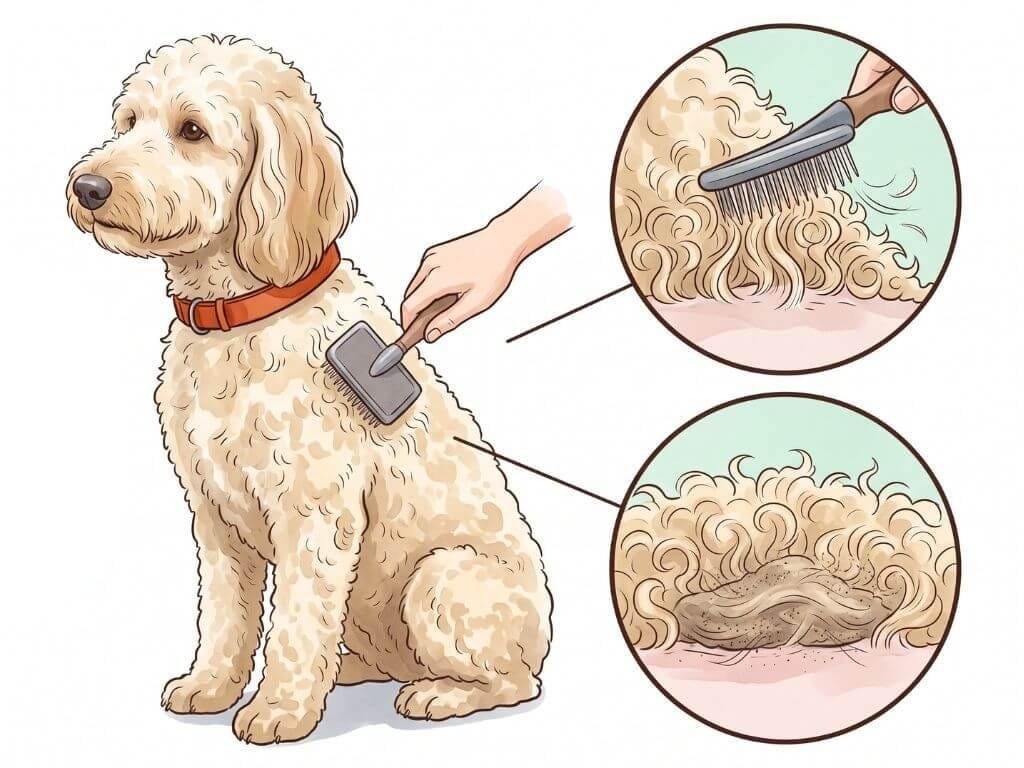
The curl you paid extra for is the curl that mats. Brushing has to reach the skin, as in the top view, because that is where shed hair and dried saliva collect. The bottom view is what a skipped week looks like: a felted mat sitting flat against the skin, holding dander that no bath can rinse out. Roughly six to eight weeks between professional grooms, and most days with a brush at home.
F1 vs f1b goldendoodle allergies: which should an allergy household pick?
An F1B, if you are choosing on odds alone, but pick the dog rather than the label.
The curlier coat of a typical F1B holds shed hair in place instead of dropping it, and less hair moving around a room means less of the dander it carries moving with it. That is a real if modest benefit. It sits a long way below the two things that actually decide your symptoms: the individual dog’s output, and your own immune system.
Here is the part that should reframe the purchase. Two dogs of the same generation, from the same litter, can differ more in allergen output than an F1 differs from an F1B on average.
A 2005 study in the journal Allergy measured coat allergen across 288 dogs and found the spread within a single breed was wide enough to swamp the differences between breeds. Generation labels are a much weaker signal than breed, and breed was already a weak one.
Buy the dog you tested, not the fraction on the paperwork.
Washing is the lever with actual evidence behind it, whatever generation you end up with. A 1999 study in the Journal of Allergy and Clinical Immunology found a wash cut recoverable coat allergen by about 84 percent, with levels back to baseline in roughly three days. That schedule matters more than F1 versus F1B ever will.
F1 vs f1b mini goldendoodle: does the mini version change anything?
Not for allergies.
A mini Goldendoodle is made by using a Miniature or Toy Poodle somewhere in the cross, bringing the adult dog to roughly 15 to 35 pounds. The generation logic works exactly the same way, so a mini F1B skews curly for the same reason a standard F1B does. Smaller dog, same proteins, same coin flip on coat.
There is a practical wrinkle worth flagging before you pay a mini premium on top of an F1B premium.
Adding more Poodle to shrink the dog also concentrates Poodle temperament, so mini doodles tend to be brighter, busier, and more demanding per pound than the standard version. Buyers who chose small expecting calm are the ones most often caught out.
Common mistakes
- Reading F1B as a guarantee. It shifts the odds toward a curly low-shed coat. Each puppy is still an individual roll.
- Treating low shedding as low allergen. The proteins come from skin and saliva. A non-shedding dog still produces them every day.
- Paying an allergy premium. You are paying for better coat odds. If a breeder prices it as an allergy solution, that is a claim they cannot support.
- Judging the coat on a puppy. Doodle coats change substantially through the first eighteen months. The eight-week fluff tells you little.
- Choosing F2 for predictability. F2 is the widest-ranging generation of all. If coat consistency matters, F1B or multigen is the honest answer.
- Forgetting the grooming cost of curl. The curlier the coat you selected for, the faster it mats and the more it costs to maintain.
FAQ
What is the difference between an F1 and F1B Goldendoodle?
An F1 is a first cross, half Golden Retriever and half Poodle. An F1B is an F1 bred back to a Poodle, making it roughly 25 percent Golden Retriever and 75 percent Poodle. The extra Poodle makes a curly, low-shedding coat much more likely, which is why breeders usually charge more for F1B puppies.
Is an F1B Goldendoodle better for allergies than an F1?
On odds, slightly, but not in the way it is sold. An F1B is more likely to have a curly coat that sheds very little, and less loose hair means less dander carried around your home. Neither generation is low-allergen, because the proteins people react to come from skin and saliva rather than hair.
Do F1B Goldendoodles shed at all?
Yes, though usually very little. Every dog sheds some hair, and a curly coat holds most of it in place until you brush it out rather than dropping it on furniture. A minority of F1B dogs inherit a wavier coat and shed more than the label led their owners to expect.
Is an F1B Goldendoodle worth the extra money?
It is, if you are buying coat predictability rather than an allergy fix. The higher price reflects a better chance of a curly low-shedding coat, which is a real benefit for a tidy household. It buys no guarantee about allergies, and it comes with a heavier grooming bill.
Which Goldendoodle generation is most predictable?
Multigen, followed by F1BB and F1B. Each backcross to a Poodle narrows the range of coats a litter can produce, while F2 pairings produce the widest variation of any generation. Predictability applies to coat type only; no generation makes allergen output predictable.
Sources
Sources (7)SourcesShow sourcesHide sources
- Cadieu E, Neff MW, Quignon P, et al. Coat variation in the domestic dog is governed by variants in three genes. Science. 2009;326(5949):150-153. https://pubmed.ncbi.nlm.nih.gov/19713490/
- Vredegoor DW, Willemse T, Chapman MD, Heederik DJJ, Krop EJM. Can f 1 levels in hair and homes of different dog breeds: lack of evidence to describe any dog breed as hypoallergenic. Journal of Allergy and Clinical Immunology. 2012;130(4):904-909. https://pubmed.ncbi.nlm.nih.gov/22728082/
- Ali MB, Evans JM, Parker HG, et al. Genetic analysis of the modern Australian labradoodle dog breed reveals an excess of the poodle genome. PLoS Genetics. 2020;16(9):e1008956. https://pubmed.ncbi.nlm.nih.gov/32911491/
- Ramadour M, Guetat M, Guetat J, El Biaze M, Magnan A, Vervloet D. Dog factor differences in Can f 1 allergen production. Allergy. 2005;60(8):1060-1064. https://pubmed.ncbi.nlm.nih.gov/15969688/
- Hodson T, Custovic A, Simpson A, Chapman M, Woodcock A, Green R. Washing the dog reduces dog allergen levels, but the dog needs to be washed twice a week. Journal of Allergy and Clinical Immunology. 1999;103(4):581-585. https://pubmed.ncbi.nlm.nih.gov/10200004/
- Bryson GT, O’Neill DG, Brand CL, Belshaw Z, Packer RMA. The doodle dilemma: how the physical health of designer-crossbreed Cockapoo, Labradoodle and Cavapoo dogs compares to their purebred progenitor breeds. PLOS ONE. 2024;19(8):e0306350. https://pubmed.ncbi.nlm.nih.gov/39196904/
- American Kennel Club. Official standard of the Poodle. https://images.akc.org/pdf/breeds/standards/Poodle.pdf
Related guides
- Goldendoodle vs Labradoodle difference. The cross-level comparison, and whether either solves allergies.
- Maltese vs Yorkie: dander, shedding, and allergy odds. The comparison hub for this silo.
- Hypoallergenic dogs: what the science actually says. Why no breed or generation earns the label.
My honest read: the F1B label is the most useful number a doodle breeder gives you, and it is still a weak one. It predicts the coat reasonably well and predicts your reaction hardly at all. Spend the afternoon with adult dogs from the same lines and let your own body cast the deciding vote.
Has a breeder quoted you an allergy premium, and did they put the claim in writing?
— Adrian V.