
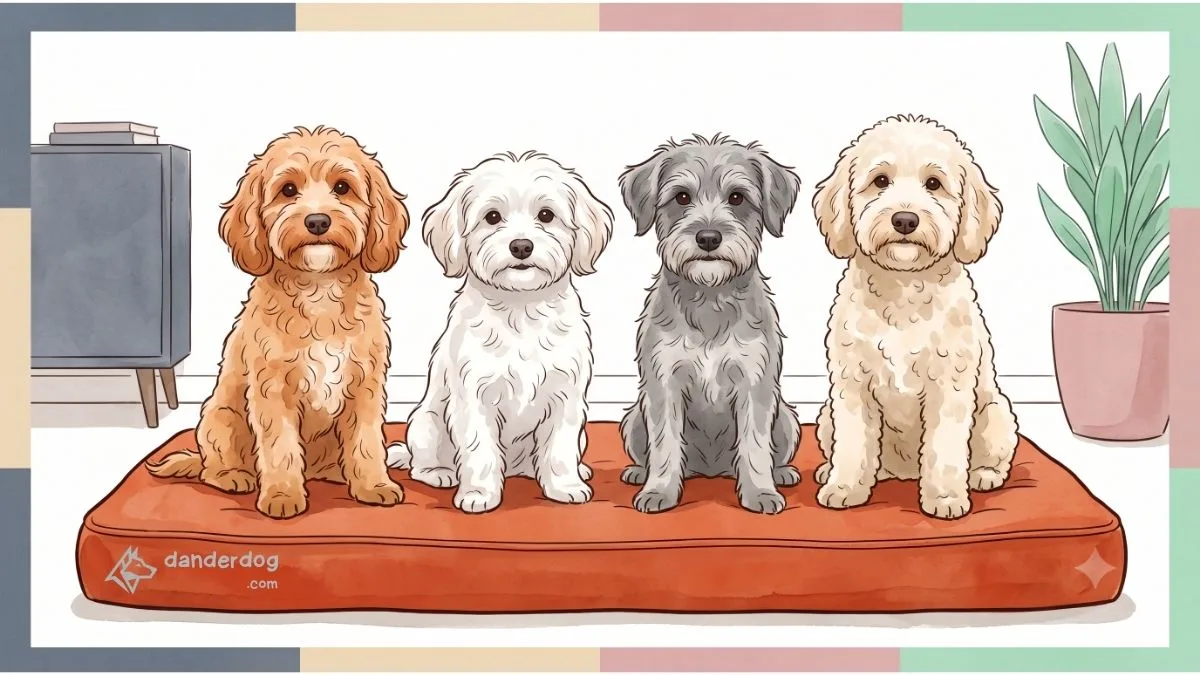
I spent a week reading breeder pages that sell mixed dog breeds that don’t shed, and here is the part they leave out: with a crossbreed, the coat is a coin toss.
A cross between a low-shedding dog and a heavy shedder does not average out to “low shed.” It can land anywhere between the two parents, and littermates from the same pair can come out different.
That is the honest starting point for anyone shopping the doodle and poo mixes.
The breeds people mean by this are the poodle and small-terrier crosses: cockapoos, maltipoos, schnoodles, yorkipoos, goldendoodles, and the rest. Some of them do shed very little.
None of them is a guarantee, though, and low shedding is not the same as low allergen. That gap is the trap most of this shopping falls into. If you want the science behind it, it lives on our hypoallergenic dogs pillar, and I will pull the load-bearing parts in below.
Quick answer
No mixed breed is guaranteed not to shed, but poodle crosses shed the least on average. The safest low-shed bets are second-generation or backcross poodle mixes (F1B cockapoos, maltipoos, schnoodles) with a curly, furnished coat. Even then, plan to test your own reaction with the exact dog before you commit, because low shedding does not mean low allergen.
Who this is for: you want a smaller shedding load in the house, maybe because someone reacts to dogs, and you are looking at mixed breeds instead of purebreds. This is the guide I wish I had before I started reading breeder sites.
If you or your child has asthma or a history of strong reactions, treat this as background only and see an allergist first.
A low-shed coat is never a green light for a severe allergy.
Key takeaways
- No dog fully stops shedding. The low-shed mixes drop less loose hair, they do not drop none.
- The trigger for allergies is dander and saliva, not the hair itself. A dog can shed almost nothing and still coat your home in allergen.
- A mix’s coat is genetically unpredictable, especially in the first generation. Curl and shedding ride on a few genes that shuffle randomly between littermates.
- Second-generation and backcross poodle mixes (F1B) are the most reliably low-shed, because they carry more poodle coat genes.
- The individual dog matters more than the breed name. Two cockapoos can differ more than a cockapoo and a Labrador.
- The move that actually helps costs nothing: spend real time with the specific dog before you decide.
Do any mixed dog breeds truly not shed?
No.
Every dog with hair sheds something, mixed breeds included. What people call a non-shedding dog is really a low-shedding one: the loose hair gets trapped in a curly coat instead of dropping on your floor.
The hair still turns over, it just stays on the dog until you brush or bathe it out.
Here is the process moment that reset my thinking. I pulled the coat-genetics research and realized the whole “non-shedding” label is describing texture, not biology.
A poodle-type curl holds shed hair in place. That is a grooming convenience, and a real one, but it does not mean the dog makes less of the stuff you are allergic to.
Low shedding and low allergen are two different things, and the gap between them is where most of this shopping goes wrong.
Which mixed breeds shed the least?
Poodle crosses, as a group, shed the least.
The pattern is simple. Breeders take a heavier-shedding dog and cross it with a poodle, because the poodle’s tightly curled coat traps loose hair.
The more poodle coat a mix inherits, the less it tends to shed. So a backcross (a mix bred back to a poodle) usually beats a straight 50-50 first cross for low shedding.
When I lined up the popular non-shed mixes, I graded them the way I wish a breeder would: not just on how much hair they drop, but on how honestly they earn the “allergy-friendly” reputation attached to them. The shedding column is fairly predictable. The allergen column is where I had to be blunt.
| Mixed breed | Parent cross | Sheds least when… | Shed grade | Honest allergen note |
|---|---|---|---|---|
| Cockapoo | Cocker Spaniel x Poodle | F1B or curly-coated | A- | Low shed, allergen still varies dog to dog |
| Maltipoo | Maltese x Poodle | Curly coat, small size | A- | Small body means less coat, not less protein per gram |
| Schnoodle | Schnauzer x Poodle | Wiry or curly coat | B+ | Two low-shed parents, coat can still come wavy and open |
| Yorkipoo | Yorkshire Terrier x Poodle | Fine silky-to-curly coat | B+ | Light shed, but Yorkie coat is hair-like and dander stays |
| Goldendoodle | Golden Retriever x Poodle | F1B, tight curl | B | F1 can shed noticeably; Golden parent is a heavy shedder |
| Labradoodle | Labrador x Poodle | F1B, wool coat | B | Measured with more coat allergen than Labradors in one study |
| Bernedoodle | Bernese Mountain Dog x Poodle | F1B, curly | B | Bernese parent sheds heavily; first cross is a gamble |
| Shih-Poo | Shih Tzu x Poodle | Curly over straight | B+ | Shih Tzu is adjacent low-shed, not low-allergen |
| Morkie | Maltese x Yorkshire Terrier | No reliable low-shed lever | B- | No poodle in the mix; both parents are adjacent low-shed |
Notice what the last column keeps saying. Nothing earns an A on allergen, and that is not me hedging. It is the finding, and I graded it that way on purpose.
The Morkie is the honest outlier. It is a lovely little dog, and it sheds lightly, but it has no poodle in it, so the low-shed reputation is thinner than the marketing suggests.
Why is a mixed breed’s coat so unpredictable?
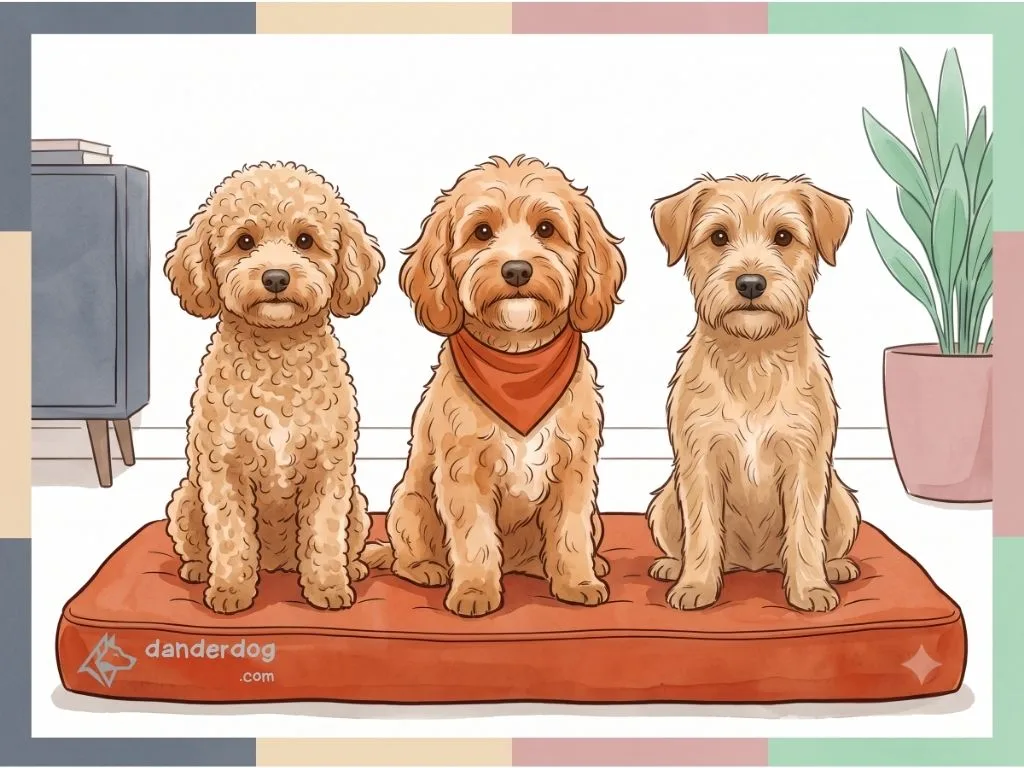
Because coat type is decided by a small number of genes that shuffle at random.
A 2009 study in the journal Science worked through more than 1,000 dogs and found that three genes account for most of the variety in dog coats: one for length, one for curl, and one for the scruffy beard-and-eyebrow look (breeders call it furnishings). A puppy inherits one copy of each from each parent. So a first-generation mix can land curly and low-shed, or flat and shedding, or anywhere in between, from the same litter.
You are, in a real sense, buying a lottery ticket when you buy an F1 puppy.
That is why the second-generation and backcross mixes are more reliable. Breeding a mix back to a poodle stacks the deck toward the curly, low-shed coat, though it does not make it certain.
Even purebred poodle-relatives throw off-type coats. A 2010 study in the Journal of Heredity traced a flat “improper coat” in Portuguese Water Dogs back to a single gene variant, in a breed that is supposed to be uniformly curly.
Here is the honest translation for your household. If low shedding is the whole reason you want the dog, do not buy a coat you have not seen and touched as an adult. A fluffy eight-week-old puppy tells you very little about the coat it will carry at two years old.
| Generation | What it means | Shed predictability |
|---|---|---|
| F1 | First cross, one poodle parent + one other breed | Low and variable; can shed like the non-poodle parent |
| F1B | F1 bred back to a poodle (about 75% poodle) | Most reliable low-shed; curlier coat, more grooming |
| F2 | Two F1 mixes bred together | Least predictable; coat genes scatter widely |
| Multigen | Several generations of mix-to-mix or mix-to-poodle | Varies by program; ask for the parents’ coats and shed history |
Are mixed breed dogs hypoallergenic?
No, and neither are mutts in general.
No dog is truly hypoallergenic, purebred or mixed. The thing people react to is a protein called Can f 1, which a dog makes in its skin and saliva, not the hair. A dog that sheds very little still makes dander (tiny flakes of dead skin) and still licks its coat, so it still spreads the protein around your home.
The clearest evidence here involves a mix directly. In a 2012 study in the Journal of Allergy and Clinical Immunology, researchers measured Can f 1 on dogs marketed as hypoallergenic, including the Labradoodle, against Labradors and a mixed control group.
The so-called hypoallergenic dogs carried more allergen in their hair and coat, not less. And there was no meaningful difference in the allergen floating around their homes.
A separate home-dust study got the same result from the other direction. When researchers grouped homes by hypoallergenic versus ordinary dogs, including mixed breeds in the groupings, no scheme showed lower dog allergen in the hypoallergenic homes.
If you forced me to give you one line for the fridge, it is this.
Low shedding manages the mess, not the allergy.
That is not a reason to skip a low-shed mix. It is a reason to test your reaction to the actual dog instead of trusting the label on the litter.
Do small mixed breeds shed less than big ones?
Not exactly. They shed less hair by volume, because there is less dog.
A maltipoo and a bernedoodle can have the same coat type, but the maltipoo has a fraction of the surface area, so it drops less total hair and holds less total dander.
That is a real, practical difference if your worry is hair on the couch or the amount of grooming.
It is not a difference in how allergenic the dog is per gram. Small hypoallergenic dogs are popular for apartments for good reasons: less hair to clean up and less dog to bathe.
Just do not read “small” as “safe.” One dog-fur study found wide swings in Can f 1 between individual dogs, with the individual dog mattering more than breed or size.
If space and shed volume are your main concern, small is a fair filter. If a real allergy is your concern, size barely moves the needle. The test-first rule does.
How do you actually lower your reaction to a low-shed mix?
Manage the allergen, not the haircut.
Once the dog is home, the levers that move your symptoms are about dander and saliva, not shedding. The single best-studied one is bathing. A 1999 study in the Journal of Allergy and Clinical Immunology found that washing a dog cut the allergen coming off its coat sharply, but the effect faded within days, so the dog needed a bath about twice a week to keep the level down.
The other big lever is where the dog sleeps. When researchers looked at what actually predicts dog allergen in a home, the strongest factors were how much time the dog spent indoors and whether it was allowed in the bedroom, not the dog’s coat type or how much it shed.
Keeping a low-shed mix out of the bedroom does more for a sensitive sleeper than the coat ever will.
| Lever | What it does | Honest effort |
|---|---|---|
| Bathe about twice a week | Cuts allergen coming off the coat; effect fades in days | High; most owners will not keep it up long term |
| Keep the dog out of the bedroom | Lowers allergen where you sleep and breathe for hours | Low; mostly a habit and a closed door |
| HEPA air purifier in main rooms | Pulls some airborne dander out of the air | Low; runs on its own once set up |
| Regular brushing and grooming | Removes trapped hair and dander from a curly coat | Medium; non-shed coats mat without it |
| Wash bedding and vacuum with HEPA | Clears settled allergen from soft surfaces | Medium; weekly routine |
None of these fixes an allergy. Together they lower the load enough that some households make it work. That is the honest ceiling, and it is worth knowing before you fall for a face.
Common mistakes
- Reading “non-shedding” as “hypoallergenic.” They are different claims. One is about hair on the floor; the other is about a protein you cannot see.
- Buying an F1 puppy for its coat. The first cross is the least predictable. If low shedding is the point, wait for an F1B or meet the adult coat.
- Trusting a fluffy puppy photo. Puppy coats change. The two-year-old coat is the one you live with.
- Skipping the time-with-the-dog test. Spending a few real hours with the specific dog tells you more than any breed page.
- Assuming small means safe. Small means less hair and less grooming, not less allergen per gram.
FAQ
What is the most low-shedding mixed breed?
A backcross poodle mix, such as an F1B cockapoo or maltipoo with a tight curly coat, is about as low-shedding as mixed breeds get. The extra poodle genes make the curly, hair-trapping coat more likely. It still needs regular grooming, and it still produces dander.
Are doodles actually hypoallergenic?
No. Doodles shed less than their non-poodle parent on average, but they still make Can f 1 in their skin and saliva. One study measured Labradoodles with more coat allergen than Labradors. Test your reaction to the specific dog before you commit.
Which mixed breed is best for allergy sufferers?
There is no single best pick, because allergen levels vary more between individual dogs than between breeds. A curly-coated F1B poodle cross is a reasonable starting point, but the deciding step is spending time with the exact dog and, for a real allergy, seeing an allergist first.
Do mixed breed dogs shed more than purebreds?
It depends entirely on the mix. A poodle cross usually sheds less than most purebreds; a cross of two shedding breeds sheds like a shedding breed. Mixing does not lower shedding on its own. The parent breeds and the coat the dog actually inherited decide it.
Can you tell if a mixed puppy will shed?
Not reliably from the puppy alone. Coat type is set by a few genes that shuffle at random, so littermates can differ. Asking to see both parents’ coats and their shed history is the closest thing to a preview, and a backcross generation improves the odds.
Sources
Sources (8)SourcesShow sourcesHide sources
- Vredegoor DW, Willemse T, Chapman MD, Heederik DJJ, Krop EJM. “Can f 1 levels in hair and homes of different dog breeds: lack of evidence to describe any dog breed as hypoallergenic.” Journal of Allergy and Clinical Immunology, 2012. https://pubmed.ncbi.nlm.nih.gov/22728082/
- Nicholas CE, Wegienka GR, Havstad SL, Zoratti EM, Ownby DR, Johnson CC. “Dog allergen levels in homes with hypoallergenic compared with nonhypoallergenic dogs.” American Journal of Rhinology & Allergy, 2011. https://pubmed.ncbi.nlm.nih.gov/21819763/
- Nicholas C, Wegienka G, Havstad S, Zoratti E, Ownby D, Johnson CC. “Dog characteristics and allergen levels in the home.” Annals of Allergy, Asthma & Immunology, 2010. https://pubmed.ncbi.nlm.nih.gov/20800790/
- Cadieu E, Neff MW, Quignon P, et al. “Coat variation in the domestic dog is governed by variants in three genes.” Science, 2009. https://pubmed.ncbi.nlm.nih.gov/19713490/
- Parker HG, Chase K, Cadieu E, Lark KG, Ostrander EA. “An insertion in the RSPO2 gene correlates with improper coat in the Portuguese water dog.” Journal of Heredity, 2010. https://pubmed.ncbi.nlm.nih.gov/20562213/
- Ramadour M, Guetat M, Guetat J, El Biaze M, Magnan A, Vervloet D. “Dog factor differences in Can f 1 allergen production.” Allergy, 2005. https://pubmed.ncbi.nlm.nih.gov/15969688/
- Hodson T, Custovic A, Simpson A, Chapman M, Woodcock A, Green R. “Washing the dog reduces dog allergen levels, but the dog needs to be washed twice a week.” Journal of Allergy and Clinical Immunology, 1999. https://pubmed.ncbi.nlm.nih.gov/10200004/
- American Kennel Club, breed and coat references. https://www.akc.org/dog-breeds/
Related articles
- Start with the science behind all of this: hypoallergenic dogs: what the science actually says.
- Comparing your options: the best dogs for allergy sufferers.
- The other side of the list: the worst dog breeds for allergies.
— Adrian V.